Materiality

In March 2015, the NTN Group signed the United Nations Global Compact, a global framework for the international community to realize sustainable growth, and we are working toward achieving the SDGs.
In December 2020, we identified 13 items of materiality that the Group should prioritize addressing in response to the SDGs. For the materiality identified, we have formulated response measures for each fiscal year and each item, and we are driving efforts to implement these measures. Our initiatives to address our materiality are outlined in a roadmap for realizing a “NAMERAKA Society,” and progress is regularly reviewed by the Sustainability Committee, which comprises members from across the organization, and reported to the Board of Directors as appropriate. (See here for the roadmap for realizing a “NAMERAKA Society.”)
The identified materialities are also linked to NTN’s corporate philosophy, “We shall contribute to international society through creating new technologies and developing new products.” By promoting efforts to address our materiality, we will strive to achieve sustainable growth for the Group and create environmental and social value, with the aim of realizing a “NAMERAKA Society.”
Identification process
STEP 1 Extraction of materiality candidates
- Extract social issues with reference to the GRI Standard, which is an international framework in the field of sustainability.
- Extract items that are candidates for materiality based on the direction of structural changes that have a major impact on the economy/environment/society and the company’s effort.
STEP 2 Evaluation and analysis of materiality candidates
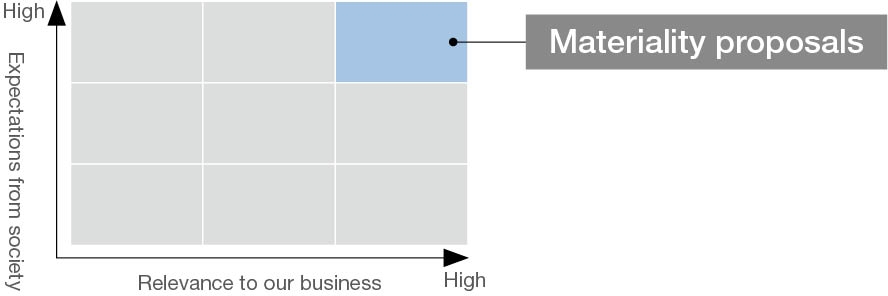
- Evaluate the 99 items extracted in STEP 1 on a three-point scale from the perspectives of “expectations from society” and “relevance to our business.”
- Organize items with high evaluations as materiality proposals.
STEP 3 Dialogue with academics and experts
- Collect suggestions and opinions from academics and experts in the field of CSR/sustainability, as well as Outside Directors regarding ideas about materiality identification and ESG strategies that should be focused on.
STEP 4 Validity assessment in overseas affiliated companies
- Conduct a questionnaire survey targeting the presidents of our overseas affiliated companies and confirm that all overseas affiliated companies agree with the materiality proposals.
STEP 5 Identify materiality
- The Board of Directors resolved 13 items of materiality.
Materiality
Contribution to solving social issues toward the future we aim for
| ESG issues | Materiality | Related SDGs | |
|---|---|---|---|
| Environment | Realize Carbon Neutrality | Respond to climate change |
|
| Contribute to carbon-free society | Realize a sustainable society using natural energy |
|
|
| Reduce energy loss |
|
||
| Social | Contribute to prosperous lives | Provide safety and comfort |
|

Foundation to support ESG management
| ESG issues | Materiality | Related SDGs | |
|---|---|---|---|
| Environment | Environmental protection | Resource recycling and pollution prevention |
|
| Social | Sustainable supply chain | Improve the reliability of products and services (Quality assurance, stable supply) |
|
| Procurement activities with an emphasis on environment and society |
|
||
| Prosperous human development | Promote safety and health |
|
|
| Respect for human rights |
|
||
| Human resource development |
|
||
| Promote diversity |
|
||
| Governance | Thorough compliance | ||
| Strengthen governance |
|
||