CSR activities in FY2019
Compliance
Basic approach to compliance
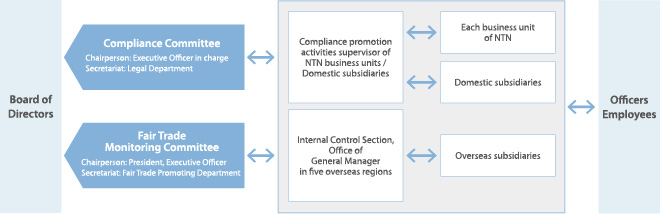
We believe that earning the trust of society is essential for us to contribute to the realization of a sustainable society and to continue to be a company needed by society. Accordingly, we are placing importance on compliance in our Management Policy. We formulated the Business Code of Conduct to specify the policy of actions which officers and employees should observe to conduct business activities in accordance with laws and regulations and generally accepted standards and practices in each country, and our internal rules. We have also established and been operating the compliance promotion structure that includes rules relating to compliance, a whistle-blower system, the Compliance Committee, and the Fair Trade Monitoring Committee.
Compliance promotion structure
We have established and been operating the Compliance Committee and the Fair Trade Monitoring Committee to promote compliance through the activities of both committees.(See Overview of the
Committees.)
Aside from the efforts made by the two committees, the Legal Department in CSR Headquarters conducts the rank-based training and the topic-specific training for officers and employees as part of compliance-related educational and awareness-raising
activities. In addition, we hold mass training meetings for Compliance Promotion Activities Supervisors in Japan once a year. By sharing information and exchanging opinions on important issues, we are enhancing the promotion activities at each
business unit and providing support for the initiatives at each business unit. Furthermore, with regard to activities for global compliance risks such as corruption prevention, we regularly exchange information and opinions with the Internal
Control section at each Office of the General Manager in the 5 overseas regions and legal/compliance departments of overseas subsidiaries, confirming each other’s ongoing activities and setting new issues.
In addition, we have established the Fair Trade Promoting Department in CSR Headquarters as an overall supervisory department for antimonopoly compliance. Under the direction of the Fair Trade Monitoring Committee, the department conducts
education, instruction, audit and other activities for relevant divisions. Additionally, overseas subsidiaries are monitored for the implementation status of antimonopoly compliance in cooperation with the Internal Control Section, within Office of
the General Manager in each region.
■Structure
Major actions to enhance compliance
| Category | Actions | Commencement (YYYY/MM) |
|---|---|---|
| Development of Structures/Policies/Rules | Internal rules on security trade control are established | 1993/12 |
| Helpline (whistle-blower system) is established and implemented | 2003/04 | |
| "Business Code of Conduct" is eatablished | 2003/05 | |
| "Business Code of Conduct Guidebook" is distributed (revised in 2018) | 2003/05 | |
| "Helpline Management Regulations" is established | 2006/11 | |
| Fair Trade promoting Department is established | 2012/04 | |
| Internal rules on antimonopoly compliance such as "Fair Trade Managemant Rules" are established | 2012/04 | |
| Fair Trade Monitoring Committee is held | 2012/05 | |
| "Five Principles to Prevent Cartels" is formulated and its handy cards are distributed | 2012/08 | |
| "Antimonopoly Compliance Handbook is distributed (revised in July 2016) |
2012/12 | |
| CSR Global Meeting is held | 2015/01 | |
| Rules for management of compliance promotion activities are established | 2015/04 | |
| Compliance promotion activities supervisors are appointed | 2015/04 | |
| Compliance Committee is held | 2015/04 | |
| Compliance training programs by Legal Department for president of each subsidiary are conducted | 2015/12 | |
| "NTN CSR Procurement Guidelines" for business partners, including compliance contents are issued | 2016/04 | |
| July 26 as "Compliance Day" is designated and President message is delivered to all NTN Group employees | 2016/07 | |
| Internal rules on bribery prevention are established | 2017/04 | |
| Internal procedures on bribery prevention management of provision of property or profit) are introduced | 2017/04 | |
| Internal procedures on bribery prevention intermediary control) are introduced | 2019/04 | |
| Internal procedures on bribery prevention (management of receipt of property or profit) are introduced | 2019/08 | |
| Educational / Awareness-raising activities | Legal Information Newsletter is issued | 1997/01 |
| Training programs by Legal Department and Fair Trade Promoting Department on specific themes (such as antimonopoly compliance, bribery prevention, security trade control and harassment prevention) for key relevant departments are conducted | 2012/01 | |
| Compliance training programs on specific themes (such as antimonopoly compliance, bribery prevention, security trade control and harassment prevention) for Operating Officers are conducted | 2012/08 | |
| Rank-based compliance training programs by Legal Department for new managers and new employees are conducted | 2015/04 | |
| Business unit-specific compliance training programs by compliance promotion activities supervisors are conducted | 2015/04 | |
| Mass training meeting by Legal Department for compliance promotion activities supervisors and staff in charge is held | 2015/04 | |
| The information-sharing database "NTN's Compliance" for presenting compliance-related incidents and promotion system is operated | 2016/08 | |
| E-learning programs (bribery prevention and antimonopoly laws) are conducted | 2017/04 | |
| Audit/Monitoring activities | Self-audits and internal audits on security trade control are conducted | 1995/10 |
| Compliance awareness survey is conducted | 2008/9 | |
| Self-audits and internal audits on antimonopoly compliance are conducted | 2012/11 | |
| Survey of Compliance awareness toward president of each subsidiary is conducted | 2017/04 | |
| Self-audits and internal audits on bribery prevention are conducted | 2018/05 |
Business Code of Conduct
The Business Code of Conduct stipulates the basic requirements for business activities that all NTN Group officers and employees in their operations must comply with.
- Compliance with laws and norms
- Pursuit of quality and safety
- Compliance with antimonopoly laws
- Fair trade with suppliers
- Honoring agreements
- Refusal to engage in improper conduct with business partners
- Proper labeling and specification
- Respect for intellectual property rights
- Proper control of confidential information
- Ensuring security by strengthening export controls
- Compliance with industrial laws
- Compliance with corporate accounting principles
- Compliance with international rules
- Promotion of environmental preservation
- Positive contribution to society
- Compliance with labor-related laws and company work rules
- Realization of a safe and positive work environment
- Respect for human rights
- Prohibition of sexual harassment
- Proper control of information about individuals
- Strict distinction between public and private matters
- Confronting harmful social forces
- Proper utilization of our information system
- Prohibition of insider trading
- Self-restraint regarding entertainment and gifts
- Lawful donations/political donations
Compliance attitude survey
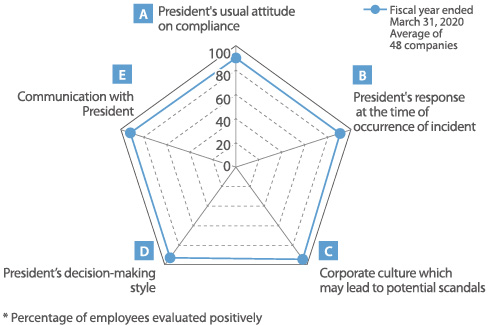
As part of our anticorruption efforts, we are examining employees'assessment of the compliance-related attitudes of division heads, affiliated companies'presidents and other senior executives.
It is said that improprieties within a company will be more likely to occur when motivations, pressures, opportunities, and justification triangles are met. It is important to develop rules and penalties, and at the same time, to develop an
internal corporate culture and environment.
This survey focuses on the corporate culture and environment and discloses the results of the survey to senior executives, aiming to create a corporate culture that "does not cause fraud" based on the awareness that fraud is constantly seen
within the company and at the head office, and to form a better compliance environment with employees.
In the fiscal year ended March 2020, we conducted a survey of 1,600 employees in our manufacturing divisions and 2,100 employees from 48 subsidiaries (12 in Japan and 36 outside Japan).
Helpline (whistle-blower system) and educational activities
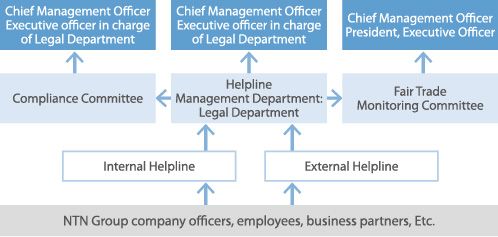
In Japan, the whistle-blower system called Helpline has been established and operated with both in-house and outside contact points to provide consultation services regarding violations of laws, Business Code of Conduct, and in-house regulations.
Helpline provides counseling services for cases such as suspected violations of labor-related laws, including harassment, as well as violations of in-house regulations, and conducts investigation in line with Helpline Management Rules that
stipulate ensuring the confidentiality and prohibition of detrimental treatment against the whistle-blower. Through the introductions in various compliance trainings and in the Code of Conduct Guidebook, we have established a structure where all
employees can utilize Helpline, not only as a tool to report misconduct, but also as a means of raising questions, opinions, and complaints regarding the Business Code of Conduct, and maintaining satisfactory relations between the company,
officers, employees, and business partners.
Whistle-blower systems are being progressively created and operated also in overseas regions, where they are tailored to local needs and circumstances.
Corruption prevention initiatives
Initiatives in Japan
We have established and have been practicing in-house rules and regulations based on domestic and overseas anti-corruption laws, generally accepted standards, and practices. In our in-house regulations, they not only prohibit bribery from and to
domestic and overseas public officials and business partners, but also specify the rules and procedures regarding provision of property or profit by our officers or employees, and rules and procedures to prevent bribery via our business partners. In
addition, under the circumstance that some countries even impose restraints on the transfer of property or profit between private companies, we have established rules and procedures for the receipt of property or profit in order to prevent bribery
by officers and employees, to thoroughly ensure the conduct of fair trade, and to prevent conflicts of interest with officers and employees. Furthermore, we made it policy to decline the provision of gifts and entertainment from our business partners
in principle.
We conduct in-house training and e-learning programs to raise awareness of the contents of our in-house rules and regulations, and conduct self-audits once a year to ensure thorough awareness of the relevant rules and
regulations. Domestic subsidiaries have also established and have been practicing their own internal regulations that are consistent with our company policies.
Initiatives in Overseas
Our overseas subsidiaries have developed and have been operating in-house rules and regulations that are localized to reflect relevant laws, regulations, and generally accepted standards and practices in each country. They also conduct audit activities related to these rules and regulations as needed. The Legal Department is regularly sharing information and exchanging views with the Internal Control Section at each Office of the General Manager in each region on related initiatives, and coordinating the systems to prevent bribery across the whole group.
Antimonopoly compliance initiatives
We regard any antimonopoly violations represent a potential risk for the whole NTN Group. To ensure thorough antimonopoly compliance, we implement various initiatives to ensure compliance with the laws.
(1)Raising employee awareness routinely
Our "CSR Policy" and "Business Code of Conduct" specify our basic policies on compliance with the antimonopoly laws. In August 2012, we established the "Five Principles to Prevent Cartels" as conduct guidelines required to prevent antimonopoly
violations as well as to protect employees therefrom. We seek to raise awareness of compliance among employees by distributing handy cards displaying these five principles. In December the same year, we distributed the "Antimonopoly Compliance
Handbook" with the aim of helping employees better understand the various rules on antimonopoly compliance. In July 2016, we revised it adding a set of specific prohibited behaviors. In addition to being distributed to employees, this is used as
a learning tool.
We also request our business partners to engage in CSR activities based on the "NTN CSR Procurement Guidelines" which includes the compliance contents referring to comply with competition laws and other laws and regulations. The status of
compliance by our business partners is verified through a questionnaire survey by our Procurement Departments. (See details of the survey here.)
【Excerpt from the NTN CSR Procurement Guidelines】
-
Compliance
- 1-1 Legal compliance
-
- We will comply with the laws of each country and region.
- We will establish and implement policies, systems and plans to provide thorough compliance.
- 1-2 Competition law compliance
-
- We will comply with competition laws of each country and region and not be involved in private monopolies, unreasonable trade restrictions (cartels, collusive bidding, etc.) and unfair business practices (abuse of a dominant position, etc.).
(2)Prevention and monitoring of contacts with competitors
Any officer or employee who might potentially contact competitors at an exhibition or meeting or any other event is obligated to apply for permission in advance and/or report it subsequently. This means we have in place a system with which we can identify the status of contact by officers and employees with competitors.
(3)Designation of Compliance Day
In 2016, we designated July 26 as "Compliance Day", on which efforts are made to further raise employees'awareness of compliance in the form of the President delivering a message about the importance of compliance in business activities to all NTN Group employees.
(4)Education
We implement training programs continually for the purpose of further raising the awareness of officers and employees about antimonopoly compliance.
【Main training results on antimonopoly compliance for the fiscal year
ended March 31, 2020】
・Training programs on antimonopoly compliance (done for managers at mainly sales departments)
・e-Learning (Theme: Procedures for contact with competitors)
・Rank-based training on antimonopoly compliance (done for new managers and new employees regardless of job category and business unit)
(5)Audit
"Self-audits" by business unit heads under the instruction of the Fair Trade Promoting Department and "internal audits" by the Internal Audit Department continue to be conducted in order to identify and evaluate the status quo to see if the
antimonopoly laws are being complied with properly in the NTN Group pursuant to relevant laws and regulations as well as internal rules.(See details of the Subcontracting Act compliance activities
here.)
In the fiscal year ended March 31, 2020, 31 departments in Japan conducted self-audits on Antimonopoly Act, and based on the results, the Internal Audit Department conducted audit. Although no serious violation was detected by the audits, we will
make improvements on the points cited in the audits in an effort to further enhance our antimonopoly compliance system.