CSR activities in FY2019
Corporate Governance
Basic Approach and Implementation System
Basic Approach
Strengthening and enhancing our corporate governance is one of our top management priorities. We take steps to make management more efficient and robust while working to increase management transparency by disclosing information in a prompt
and accurate manner to shareholders and investors.
We made a transition from a Company with Board of Company Auditors to a Company with Nominating Committee, etc. upon the approval of the 120th General Meeting of Shareholders held on June 25, 2019 (for the fiscal year ended March 31,
2019). The purpose of this transition is to establish a prompt decision-making structure and operational execution organization, strengthen the supervision of management, and improve management transparency and fairness. Under this
structure, we will work on further improvement of corporate value over the medium- and long-term.
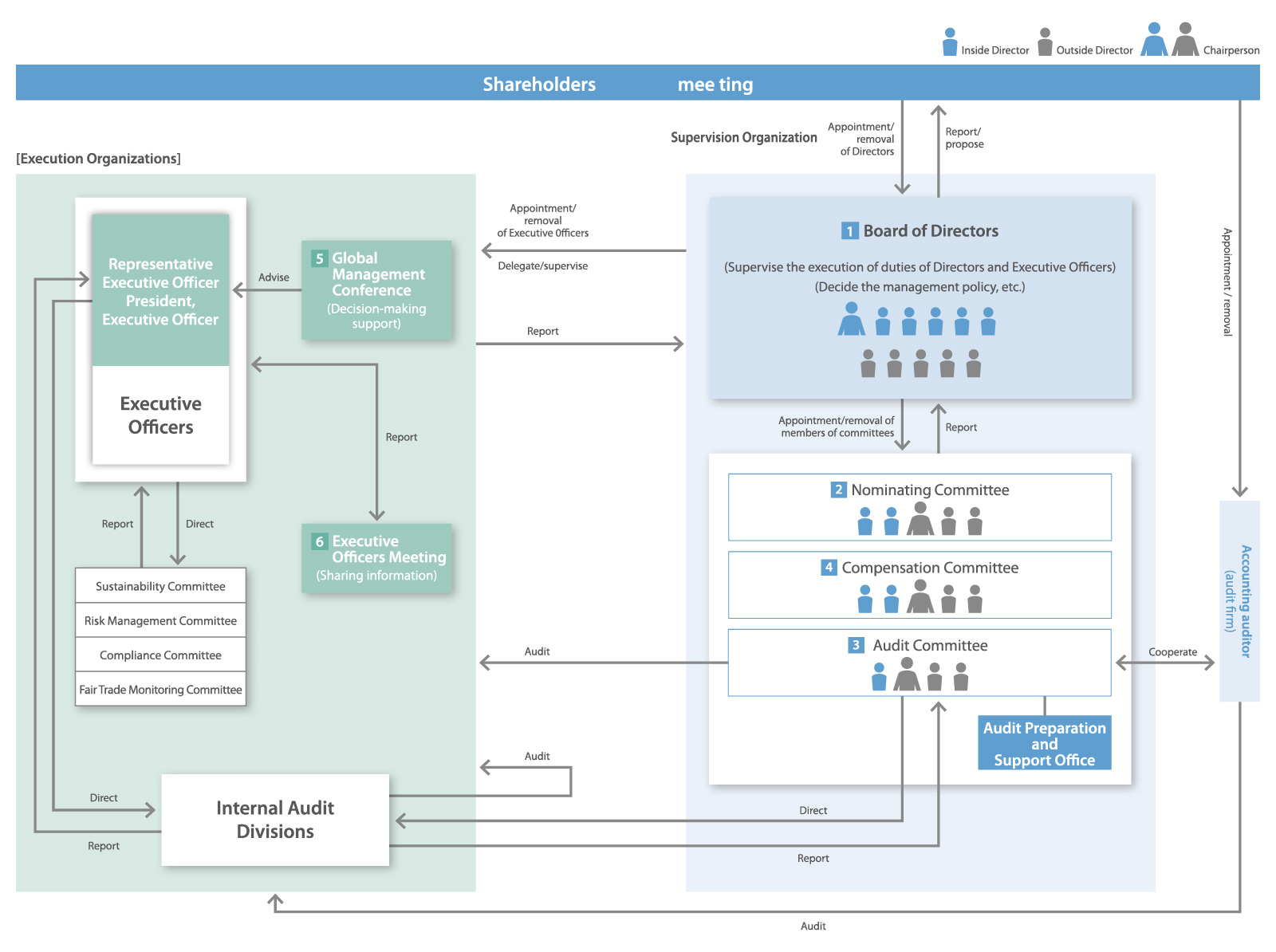
■Corporate governance structure (as of July 30, 2020)
Board of directors
The Board of Directors decides the basic management policies, and supervises the execution of duties of Directors and Executive Officers. Except matters stipulated by laws and regulations or the Articles of Incorporation, the Board of
Directors delegated substantial authority to Executive Officers with the aim to strengthen the supervision of management, and make decisions more promptly.
The Board of Directors is held once a month in principle, but it is also held flexibly as needed.
The Articles of Incorporation specify that the term of office of Directors shall be one year, and the number of Directors shall be within 15. The number of Directors is 11 as of July 30, 2020, and five of them are Outside Directors. The
Board of Directors is chaired by Director, President, Executive Officer.
Nominating Committee
The Nominating Committee decides on the content of a proposal regarding appointment/ removal of Directors, which is submitted to the General Meeting of Shareholders. The majority of the members are Outside Directors. Three out of the five members of the committee are Outside Directors, and the committee is chaired by an Outside Director.
Audit Committee
The Audit Committee audits the execution of duties of Directors and Executive Officers, and decides on the content of a proposal regarding appointment/removal of the accounting auditor, which is submitted to the General Meeting of
Shareholders. The majority of the members are Outside Directors. Three out of the four members of the committee are Outside Directors, and the committee is chaired by an Outside Director.
Also, the Audit Preparation and Support Office is established as an organization dedicated to support the duties of the Audit Committee, including Secretariat of Audit Committee. Regarding matters relating to appointment, personnel
relocation, disciplinary punishment, evaluation, etc. of staff of the Audit Preparation and Support Office, the approval from the Audit Committee shall be required for decision.
Compensation Committee
The Compensation Committee decides on the policy for compensation for Directors and Executive Officers, and details of compensation for individual persons. The majority of the committee are Outside Directors. Three out of the five members of the committee are Outside Directors, and the committee is chaired by an Outside Director.
■Members composing Nominating Committee, Audit Committee, and Compensation Committee Year ended March 31, 2021 (As of July 30, 2020)
| Director | Nominating Committee |
Audit Committee |
Compensation Committee |
|---|---|---|---|
| Hiroshi Ohkubo | ○ | ○ | |
| Hideaki Miyazawa | |||
| Eiichi Ukai | |||
| Toshinori Shiratori | ○ | ○ | |
| Masaki Egami | |||
| Keiji Ohashi | ○ | ||
| Noboru Tsuda ★ (Non-standing) |
◎ | ○ | |
| Kouji Kawahara ★ | ○ | ◎ | |
| Ryo Kawakami ★ (Non-standing) |
○ | ◎ | |
| Tomonori Nishimura ★ (Non-standing) |
○ | ○ | |
| Yuriya Komatsu ★ (Non-standing) |
○ |
※★Please note that persons with are Outside Directors, persons with are Chairperson of committees,and persons with are members of committees.
Management Meeting
The Management Meeting discusses important matters relating to operational execution, as a supporting body for decision-making of President, Executive Officer. The meeting is composed of President, Executive Officer, and Executive Officers who are designated by him, and held twice a month in principle.
Executive Officers Meeting
The Executive Officers Meeting is held by President, Executive Officer under the attendance of all Executive Officers. Matters resolved at the Board of Directors are instructed, and each Executive Officer reports about the status of operational execution. This meeting is held once a month in principle, to make operational execution more efficient and effective by sharing information among Executive Officers.
Executive Officer
Executive Officers are elected by the resolution of the Board of Directors, and are in charge of executional decision making and execution of operations delegated by the Board of Directors. Its term of office is specified as a year by the Articles of Incorporation. The number of Executive Officers is 11 as of July 30, 2020.
■Basic information
|
Organizational design |
Company with Nominating Committee, etc. |
|---|---|
|
Directors |
11 |
|
Of those, independen |
5 |
|
Term of office of Directors |
1year |
|
Executive Officers |
11 |
|
Of those, Executive |
3 |
|
Executive Officers |
5 |
|
Structure to support duties of Audit Committee |
Available (Audit Preparation and Support Office) |
|
Accounting auditor |
Ernst & Young ShinNihon LLC |
Directors
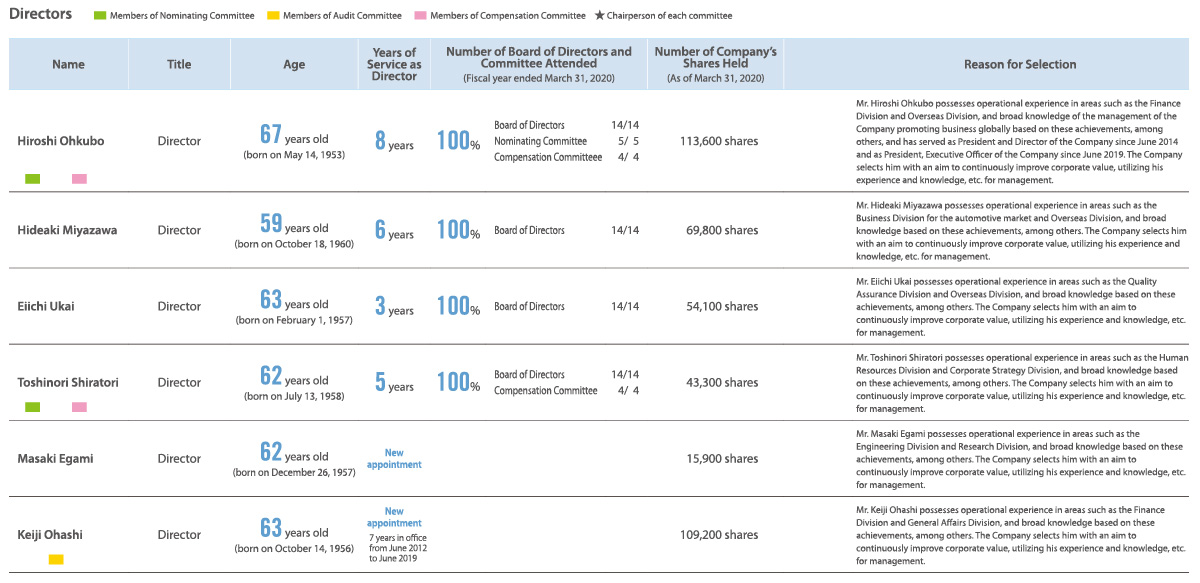
■Directors①
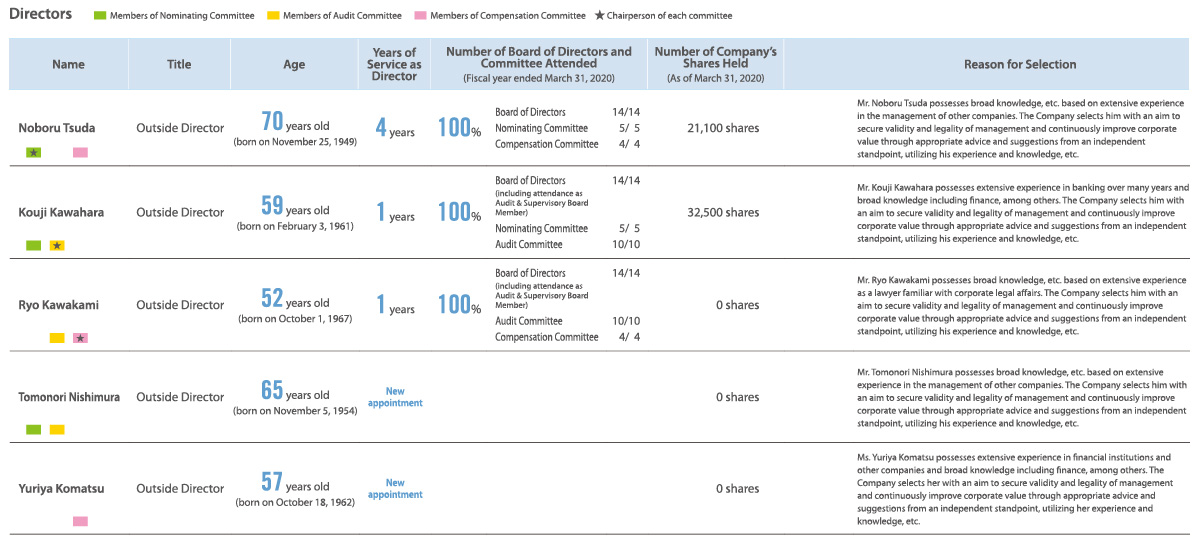
■Directors②
Executive Officerss
| Name | Title | Responsible |
|---|---|---|
| Hiroshi Ohkubo* |
Representative Executive Officer, President, Executive Officer |
CEO (Chief Executive Officer) |
| Hideaki Miyazawa* |
Representative Executive Officer, Senior Managing Executive Officer |
Corporate General Manager, Automotive Business Headquarters Procurement Headquarters |
| Yoshinori Terasaka |
Senior Managing Executive Officer |
Europe & Africa Region Americas Region |
| Eiichi Ukai* |
Representative Executive Officer, Managing Executive Officer |
Aftermarket Business Headquarters Industrial Business Headquarters Quality Assurance Headquarters NTN Korea Co., Ltd. ASEAN, Oceania & West Asia Region India Region |
| Toshinori Shiratori* |
Managing Executive Officer |
Human Resources CSR Headquarters Information Technology Department General Affairs Department EHS (Environment, Health and Safety) Integrated Management Department |
| Masaki Egami* | Executive Officer |
CTO (Chief Technology Officer)
Research Division New Product and Business Strategic Planning Headquarters Green Energy Products Division |
| Isao Ozako | Executive Officer |
Corporate General Manager, Production Headquarters Production Engineering R&D Center Composite Material Product Division |
| Masayuki Kaimi | Executive Officer |
Supply & Demand Center Cost Planning Department China Region |
| Koji Kametaka | Executive Officer |
Deputy Corporate General Manager, Automotive Business Headquarters General Manager, Electric Module Products Division EV Module Division |
| Tetsuya Sogo | Executive Officer |
CFO (Chief Financial Officer) Corporate General Manager, Finance Headquarters |
| Masaaki Yamamoto | Executive Officer |
Corporate General Manager, Corporate Strategy Headquarter |
* Executive Officers currently serving as Directors
Governance-strengthening transition
|
2004 |
|
|---|---|
|
2006 |
|
|
2008 |
|
|
2011 |
|
|
2012 |
|
|
2015 |
|
|
2016 |
|
|
2018 |
|
|
2019 |
|
|
2020 |
|
Board of Directors
Approach of Board of Directors
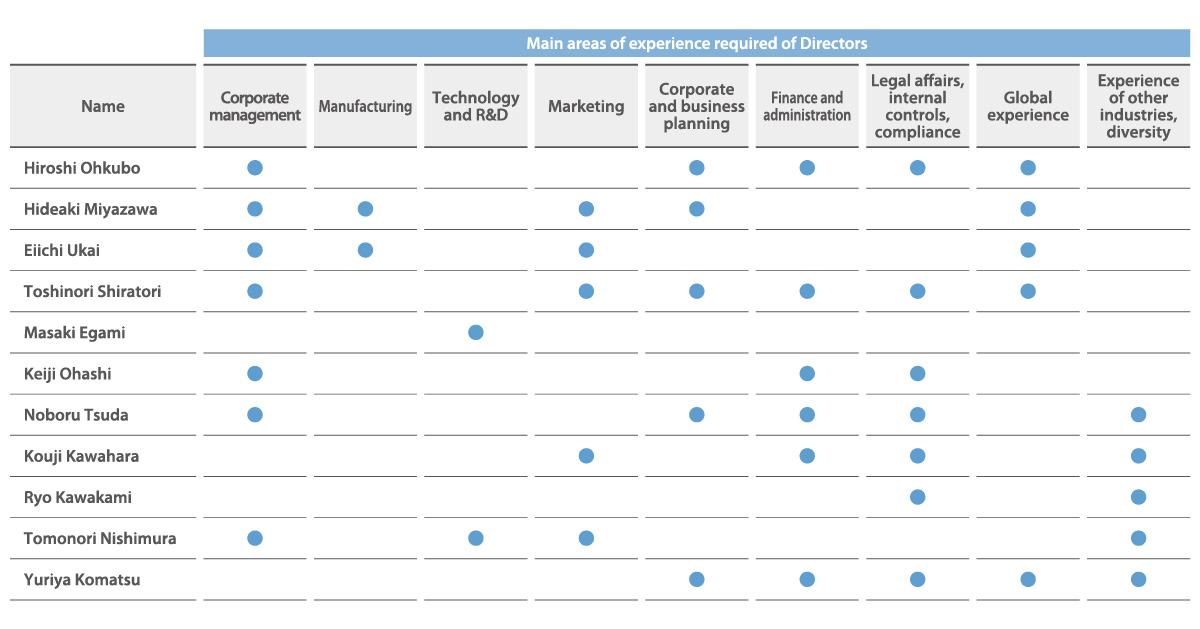
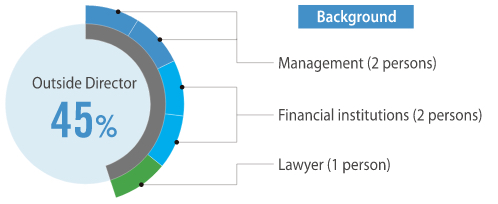
Directors other than Outside Directors are appointed from a wide range of fields, including manufacturing, marketing, technology, and administrative divisions. In addition, Outside Directors are appointed after considering diversity and balance, such as being a person with knowledge of finance, experienced management, and being a lawyer. We believe that the current number of Directors is an appropriate size for strengthening corporate governance and expanding our global businesses.
Appointment of the first female Director
Upon the approval of the General Meeting of Shareholders in the fiscal year ended March 2020, a female Director (Outside Director) was newly appointed the first time at the Company. The female Director with experience in a different industry than ours will supervise management. This will enable us to integrate diverse values and accelerate transformation aimed at achieving sustainable growth.
Assessment of effectiveness of the Board of Directors
We conducted a self-assessment of the Board of Directors by sending out questionnaires to Directors from the viewpoints such as role/structure/management of the Board of Directors and management of committees. The result was generally positive, but there were comments regarding a succession plan of top management (CEO) and others. Based on those, discussions were held on future actions and others at the Board of Directors. We will continue to analyze and evaluate the effectiveness of the Board of Directors on a regular basis to make improvements.
The main areas of experience of Directors (Skill matrix)
Nominating Committee
Members, the number of meetings, and attendance
| Name | Title | Attendance | Number of attendances |
|---|---|---|---|
| Noboru Tsuda | Chairman Outside Director |
100% | 5 times/5 times |
| Kouji Kawahara | Outside Director | 100% | 5 times/5 times |
| Akira Wada* | Outside Director | 100% | 5 times/5 times |
| Hiroshi Ohkubo | Director | 100% | 5 times/5 times |
| Hironori Inoue* | Director | 100% | 5 times/5 times |
Retired at the conclusion of the General Meeting of Shareholders in the fiscal year ended March 31, 2020
Discussions on Nominating Committee
The Nominating Committee was established in conjunction with the transition to a Company with a Nominating Committee, etc. The committee was held five times in total in the fiscal year ended March 31, 2020, with discussions held and resolutions made mainly on the standards for selection of Directors, skill matrix related to standards for selection and the standards regarding the independence of Outside Directors.
About Outside Directors
We made a transition from a Company with a Board of Company Auditors to a Company with a Nominating Committee, etc. upon the approval of the General Meeting of Shareholders for the fiscal year ended March 31, 2019. The Board of Directors
consists of 11 members, including six Inside Directors and five Outside Directors, and the ratio of Outside Directors is 45%. The purpose of this transition is to strengthen the supervision of management and improve management transparency
and fairness. In addition, in order to ensure appropriate corporate governance, we have established our own standards regarding the independence of Outside Directors, stipulating qualification and independence standards for them. This
standard is used for appointing Outside Directors. Also, all the Outside Directors are designated as independent Officers as defined by the rules of Tokyo Stock Exchange, Inc. (TSE), and are reported to TSE.
For Outside Directors, we have established an environment where the secretariat or any other party explains the issues as appropriate prior to the Board of Directors so that active discussions can be made at the Board of Directors.
Moreover, we continuously provide information necessary for Outside Directors to effectively fulfill their roles and responsibilities by creating opportunities to deepen their understanding of our business through on-site tours of business
sites and other means.
Standards for Selection of Directors
The selection of candidates for Directors will be determined based on standards for selection of Directors described below, considering the gender and international diversity and balance of the Board of Directors as a whole, after careful deliberation in the Nominating Committee. The appointment of an Executive Officer shall be also determined after careful deliberation by the Board of Directors, including Outside Directors, comprehensively considering whether they possess personalities, insights, capabilities, experience/performance, etc. that are appropriate for fulfilling their duties. In addition, if it becomes clear that an Executive Officer lacks the required qualifications, he/she will be promptly dismissed by the Board of Directors, including Outside Directors.
Standards for Selection of Directors
- Must be in good condition both physically and mentally.
- Must have a high sense of ethics and a law-abiding spirit.
- Must be able to engage in constructive discussion from an objective viewpoint.
- Must be highly motivated to improve their abilities.
- Must have excellent decision-making skills from a company-wide and medium- to long-term perspective.
- Must have excellent insight and foresight concerning changes to the overall environment and to society.
- Must have a sufficient record of performance and expertise in relevant fields. (Corporate manager or expertise)
- Outside Directors must (1) have sufficient time to accomplish their duties, (2) satisfy the standards regarding the independence of Outside Directors, (3) ensure diversity between the Outside Directors, and (4) have the requisite abilities to accomplish duties as a member of any of the three Committees.
Compensation Committee
Members, the number of meetings, and attendance
| Name | Title | Attendance | Number of attendances |
|---|---|---|---|
| Akira Wada* | Chairperson Outside Director |
100% | 4 times/4 times |
| Noboru Tsuda | Outside Director | 100% | 4 times/4 times |
| Ryo Kawakami | Outside Director | 100% | 4 times/4 times |
| Hiroshi Ohkubo | Director | 100% | 4 times/4 times |
| Toshinori Shiratori | Director | 100% | 4 times/4 times |
Retired at the conclusion of the General Meeting of Shareholders in the fiscal year ended March 31, 2020
Discussions at the Compensation Committee
Following the transition to a Company with a Nominating Committee, etc., we held the Compensation Advisory Committee from April to June 2019 and the Compensation Committee from June 2019 to March 2020. The Compensation Committee aims to improve fairness, transparency, and objectivity of procedures regarding the decision making of compensation for Directors and Executive Officers and enhance corporate governance. Also, the committee passed resolutions regarding the details of compensation (such as compensation specified for each individual) of Officers.
■Compensation Advisory Committee (April 1, 2019 -June 24, 2019)
|
1st |
Performance of BIP Trust Results for compensation of Officers |
|---|---|
|
2nd |
Bonus for Directors FY2019 summer bonus for Executive Officers Discussion on composition and amount of compensation for Officers Revision of stock issuance regulations and internal regulations concerning BIP Trusts for compensation for Officers |
■Compensation Committee (June 25, 2019 - March 31, 2020)
|
1st |
Decision of the order of substitution for the chairperson in the event of an accident Policy for determining the amount, or method of calculation, of compensation for Officers Individual compensation for Directors and Executive Officers Signing a memorandum concerning the revision of stock issuance regulations, internal regulations and the trust contract Notice regarding for the revision of the system of BIP Trust for compensation for Officers Compensation Committee's annual activity plan |
|---|---|
|
2nd |
Reduction of compensation for Directors and Executive Officers Validation for level and structure of compensation for Directors, Executive Officers, and Operating Officers 2019 winter bonus for Executive Officers |
|
3rd |
Performance targets of BIP Trust for compensation for Officers in line with revision of Medium-Term Management Plan Prerequisites for bonus payment for Executive Officers Compensation for Directors and Executive Officers for the next fiscal year Bonus for Executive Officers |
|
4th |
Compensation for Directors and Executive Officers for the next fiscal year |
Policies for determining the amount, or method of calculation, of compensation, etc., for Officers
The system and level of compensation for Officers, compensation specified for each individual, etc. are determined in the Compensation Committee chaired by an Outside Director using objective information including the level and trends of other companies as reference. Compensation for Executive Officers and compensation for Directors are determined separately, and if a Director also serves as an Executive Officer, those compensations are added up.
Compensation for Executive Officers
Compensation for Executive Officers consists of basic compensation, which is a fixed compensation, and performance-linked compensation, which fluctuates according to performance. The ratio of basic compensation to performance-linked compensation is approximately 6:4 as a standard.

Basic compensation shall be determined based on a relevant Executive Officer's role and increased in the case of, for example, Executive Officers who have the right to represent.
■Annual incentives
The payment amount shall be decided in consideration of the status of progress of measures for achieving key targets for each Executive Officer, on the basis of the performance level in the applicable fiscal year.
■Medium- and long-term incentives
The Company’s shares shall be issued based on the achievement level of major target figures in the Medium-term Management Plan (money equivalent to the converted amount of shares shall be paid for a certain portion) as
incentives to motivate them to achieve the targets in the Medium-term Management Plan and contribute to raising shareholder value, and in order to promote the holding of the Company’s shares.
Medium- to long-term performance targets
include key performance indicators (consolidated operating margin, consolidated net sales, etc.) that take into account the Company's management policies.
Compensation for Directors
Compensation for Directors consists of basic compensation, which is a fixed compensation. Basic compensation shall be calculated taking into account concurrent duties of an Executive Officer, whether a Director works full-time or part-time, the committees to which a Director belongs, and his/her role.
Audit Committee
Members, the number of meetings, and attendance
| Name | Title | Attendance | Number of attendances |
|---|---|---|---|
| Kouji Kawahara | Chairperson Outside Director |
100% | 10 times/10 times |
| Tadao Kagono* | Outside Director | 90% | 9 times/10 times |
| Ryo Kawakami | Outside Director | 100% | 10 times/10 times |
| Hironori Inoue* | Director | 100% | 10 times/10 times |
Retired at the conclusion of the General Meeting of Shareholders in the fiscal year ended March 31, 2020
Discussions at the Audit Committee
Following the transition to a Company with a Nominating Committee, etc., we held meetings of the Board of Corporate Auditors from April to June 2019 and meetings of the Audit Committee from June 2019 to March 2020. Major items to be discussed at the Audit Committee include the formulation of the Audit Committee’s auditing standards, the formulation of auditing policies and auditing plans, the evaluation of the content of auditing plans of the independent auditors, the assessment of the selection of independent auditors, and the assessment of the status of development and operation of internal control systems.
Audit Status
The Audit Committee members attend meetings of the Board of Directors and other major meetings based on auditing standards, policies, and plans determined by the Audit Committee. The Audit Committee receives reports or hears from Directors, Executive Officers, employees, etc. on the status of the execution of their duties, and audits the execution of duties by Directors and Executive Officers. In addition to the Board of Directors and Executive Officers Meeting, members of the Audit Committee attend and monitor the Risk Management Committee, the Compliance Committee, and the Fair Trade Monitoring Committee, which operate internal control systems.
Overview of the Committees
Sustainability Committee
The Sustainability Committee is chaired by Executive Officer responsible for CSR Headquarters, and is vice-chaired by corporate general manager, with members consisting of the heads of ESG-related divisions. Each employee in our group
should promote sustainability activities based on the 3 fundamental principles of our Corporate Philosophy, CSR Basic Policy, and Action of Business Conduct in our day-to-day business activities.
The committee is responsible for
identifying key issues (materiality) and establishing targets for achieving SDGs in order to examine initiatives related to sustainability.
Risk Management Committee
We have established the Risk Management Committee, chaired by Executive Officer (Executive Officer in charge of risk management), who is responsible for the Global Risk Management Department, as an advisory body on risk management to prevent risks from occurring and minimize damage in the event of a crisis. The committee consists of the general managers of the promotion department of risk management, responsible departments in subsidiaries. The committee regularly checks the situation of risks surrounding the group, and formulates the group-wide risk management plan and discusses matters such as the BCP/BCM. The result of discussion at the Risk Management Committee is reported to Board of Directors and instructions are fed back to the relevant departments.
Compliance Committee
The Compliance Committee, chaired by Executive Officer in charge of CSR Headquarters (Overall Control Administrator of Compliance Promotion Activities), handles global compliance risks, excluding violation risks of the Anti-Monopoly Act and the Subcontracting Act. The committee members are comprised primarily of the heads of related risk management divisions. The committee members formulate and implement risk mitigation measures in cooperation with the Compliance Promotion Activities Supervisors appointed at each business unit in Japan and the Internal Control Section established at each Office of the General Manager in 5 overseas regions, and reports to the committee on action plans and the status of implementation. The committee deliberates on the contents of them and reports the findings to Board of Directors.
Fair Trade Monitoring Committee
The Fair Trade Monitoring Committee is chaired by President, Chief Executive Officer and consists of Executive Officers in charge of sales and procurement divisions, Outside Director, external lawyer and so on. In principle, this meeting is held twice a year to discuss the implementation plans and the performance reports for compliance with the Antimonopoly Act and the Subcontracting Act, and to provide supervision and guidance on effective control for fair trade practices along with education and awareness-raising activities. In addition, we have established the Fair Trade Promoting Department in CSR Headquarters as an overall supervisory department for antimonopoly compliance. Under the direction of the Fair Trade Monitoring Committee, the department conducts education, instruction, audit and other activities for relevant divisions. Furthermore, overseas subsidiaries are monitored for the implementation status of antimonopoly compliance in cooperation with the Internal Control Section, within Office of the General Manager in each region.
Subsidiary management structure
Under the provisions of the Management Rules for Subsidiaries, we maintain a system for subsidiaries management by concluding a letter of confirmation concerning management control with subsidiaries. Under the system, subsidiaries will report the execution status of duties of their directors, and request the Company’s approval for certain matters. In addition, based on the letter of confirmation, we develop systems for internal control, promotion of CSR activities, risk management, promotion of compliance activities, security trade control, and compliance of laws on competition. We also widely notify and operate a helpline (whistle-blower system) to subsidiaries as a contact point for various concerns.
Clarification of control structure by concluding a letter of confirmation concerning management control
- Report the status of execution of duties by subsidiaries’directors
- Application from subsidiaries for the headquarters'approval for certain issues, on the basis of authorization rules
- Development of internal control system
- Development system for promotion of CSR activities
- Compliance of basic policy of risk management
- Development system for promotion of compliance activities
- Development system for security trade control
- Instruction and audit of compliance of laws on competition
Securing responsiveness to Corporate Governance Code
We take active measures to strengthen our corporate governance while securing responsiveness to the purport of the Corporate Governance Code, including the transition to a Company with Nominating Committee, etc. in June 2019. We have implemented all of the general principles of the Corporate Governance Code. We will continue to work on strengthening our corporate governance while adapting to changes in our business environment.