CSR activities in FY2019
Relationships with Business Partners
Basic approach to procurement activities
Based on the perspectives of "Globalization," "Fairness/Impartiality," and "Environmental Preservation," we have built trusting relationships with our business partners and are conducting procurement activities centered on our head office purchasing divisions. Furthermore, based on the "NTN Group Green Procurement Standards," we are promoting green procurement, which prioritizes environmental preservation efforts and procurement from business partners with superior environmental quality. We have also established "NTN CSR Procurement Guidelines" and are requesting active promotion of CSR activities. We are also working to achieve local procurement at all of our manufacturing sites, including those outside Japan, and to procure materials from optimal locations globally.
Various procurement policy
Green Procurement Standards
Failure to comply with environment laws and environmentally-hazardous substances regulations in the supply chain is a management risk that leads to shut-down and compensation for damages to customers. We are promoting environmental control throughout the supply chain by establishing green procurement standards that require our business partners to establish an environmental control system and define the standards of environmentally-hazardous substances, which constitute the important quality characteristics of delivered products.
CSR Procurement Guidelines
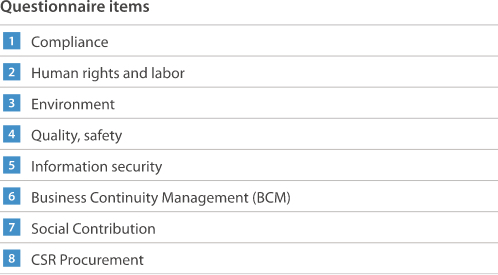
We have established NTN CSR Procurement Guidelines to promote activities throughout the entire supply chain in response to social issues such as human rights and labor practices, environmental issues, the elimination of anti-social forces, and anti-corruption. We request our business partners to further promote CSR procurement activities in areas such as compliance and anti-corruption, human rights and labor, environmental issues, quality and safety, information-security, business continuity, and social contribution.
Procurement complying with environmental regulations
In order to comply with environmentally-hazardous substances regulations in Japan and overseas and customer standards, we actively switch regulated substances regardless of applications, destinations, or manufacturing locations. To comply with the RoHS Directive which was revised in July 2019 and prohibits phthalates (DEHP, BBP, DBP and DIBP), we have established a system for incoming inspection according to the risks involved. We are promoting the switching from lead-containing procured products that are currently used for applications exempted from the RoHS Directive, assuming future tightening of regulations.
CSR questionnaire for suppliers
NTN We conduct annual surveys of business partners to further raise awareness of "NTN CSR Procurement Guidelines" and to confirm compliance.
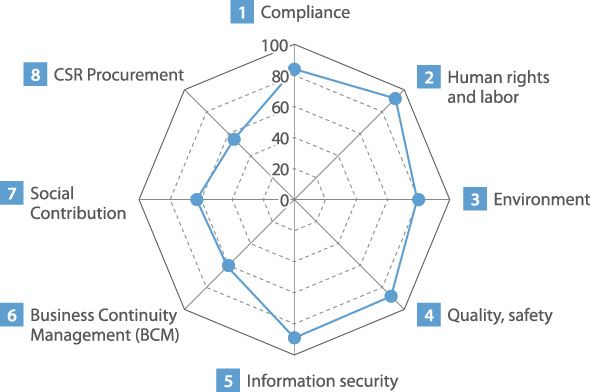
In the fiscal year ended March 31, 2020, we surveyed 240 suppliers, such as those who responded that they were not successful in the last fiscal year's survey and those who have newly begun business with us from FY2019.
In most of the items, the status of efforts has been improved since the previous survey, and they have a better understanding of the importance of CSR procurement. However, with regard to information security and business succession management, some suppliers became aware of issues such as new threats under their work systems which were introduced in line with the state of emergency declaration in response to the spread of the new coronavirus (COVID-19) infections. We will further continue to work on raising awareness of the CSR procurement.
■CSR questionnaire for suppliers
Compliance with Subcontracting Act
We conduct self-audits of subcontract transactions with the aim of optimizing subcontract transactions. In order to voluntarily audit the compliance status of the Subcontracting Act, each business site in Japan is responsible for implementing a certification system for "subcontracting self-auditor." In September 2019, we held a "Self-Auditor Training Course for Subcontract Transactions" and newly certified 26 employees as self-auditors. The total number of self-auditors reached 108. In the fiscal year ended March 2020, self-audits were conducted at our 22 business sites in Japan, with the self-auditors playing a leading role in such audits. We will continue to conduct activities aimed at optimizing subcontract transactions.
Conflict minerals survey
We periodically investigate whether or not certain minerals contained in our materials or components are sources of funds of armed groups in conflict areas, which leads to human rights violations, illegal mining and smuggling.
In FY2019, we traced back through our supply chain of 297 business partners to identify the material smelters, and more than 90% of such partners reported that they do not use any conflict minerals.
We will continue to conduct this survey periodically to monitor the inclusion of conflict minerals from conflict or high-risk regions.
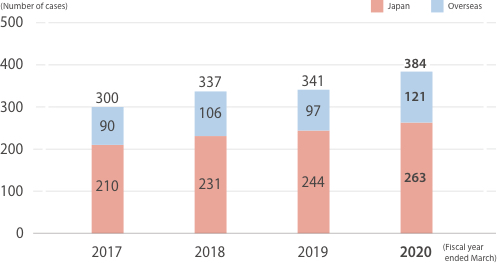
Companies listed on U.S. Stock Exchanges are required to disclose the use of conflict minerals under the U.S. Dodd-Frank Act. Based on the results of the above survey, we respond to inquiries from our customers regarding conflict minerals.As human rights issues are gaining attention globally, corporate awareness of such issues is growing. Regardless of the U.S. Dodd-Frank Act, the number of companies voluntarily eliminating the use of conflict minerals is increasing as shown in the chart below.
NTN will continue to deal with conflict minerals as part of our supply chain CSR.
■Number of conflict mineral surveys (reports to our customers)
Risk management for suppliers
From the perspective of management of risks associated with our business partners, before starting new transactions, we check the management status of business partners as well as their management of quality and environmental issues.
We also conduct an annual survey for business partners, which we have already conducted transactions with, to continuously monitor their business conditions.
In addition, for suppliers who are deemed to have high transaction risks, we implement risk-reducing measures commensurate with the impact they may have on us in terms of procurement parts, transaction amounts, etc., in an effort to minimize procurement risks and ensure stable procurement activities at all times.
Recently, business continuity risks such as natural disasters and infectious diseases have been increasing, and we have created a crisis management database to prepare for unforeseen circumstances. In the event of an emergency, we promptly confirm the safety of our business partners and manage risks related to the stable supply of products throughout the supply chain.
Supply chain BCP
We are promoting supply chain BCP activities including logistics and business partners in order to ensure stable procurement.
We are strengthening crisis-management in preparation for natural disasters such as earthquakes and typhoons at our business partners and distribution bases. In addition, in a widespread crisis such as a pandemic, we will cooperate with our business partners to ensure the business continuity, and promote infrastructure development such as on-line business operations with our business partners, the safety confirmation at the time of disaster, sharing the safety information and the code of conduct.