CSR activities in FY2023
Realizing Carbon Neutrality
Response to Climate Change
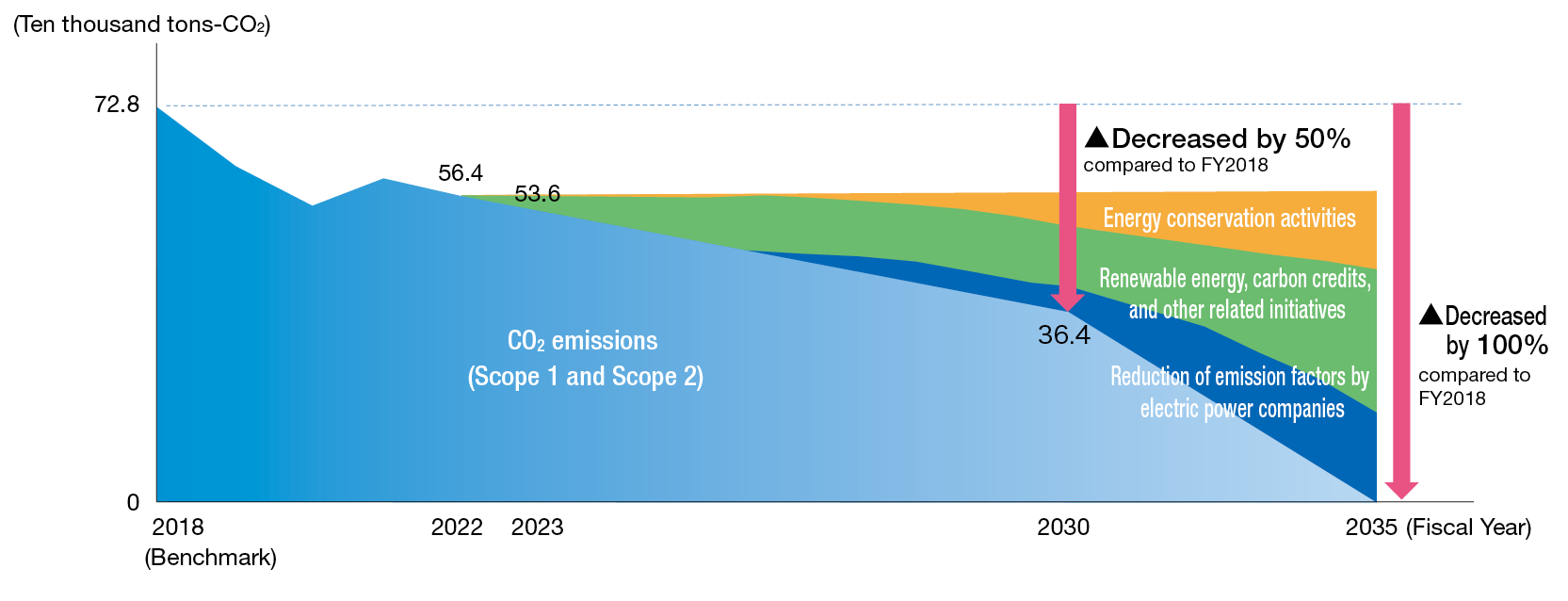
The NTN Group is promoting carbon neutrality activities in response to climate change and has set the targets of reducing Scope 1 and 2 emissions by 50% by FY2030 against FY2018 levels, achieving carbon neutrality by FY2035, and achieving carbon neutrality for Scope 3 emissions by FY2050. To that end, we are promoting CO2 emission reductions in our business activities. FY2018 is set as the base year as it was the most recent fiscal year not affected by production cuts due to the COVID-19 pandemic.
*We calculate and report only energy-based carbon dioxide (CO2) emissions.
■NTN’s carbon neutrality targets
CO2 emission reduction target (Scope 1 and Scope 2)
50% reduction by FY2030(compared to FY2018)
Achieve carbon neutrality by FY2035
CO2 emission reduction target (Scope 3)
Achieve carbon neutrality by FY2050
Establish a global promotion system
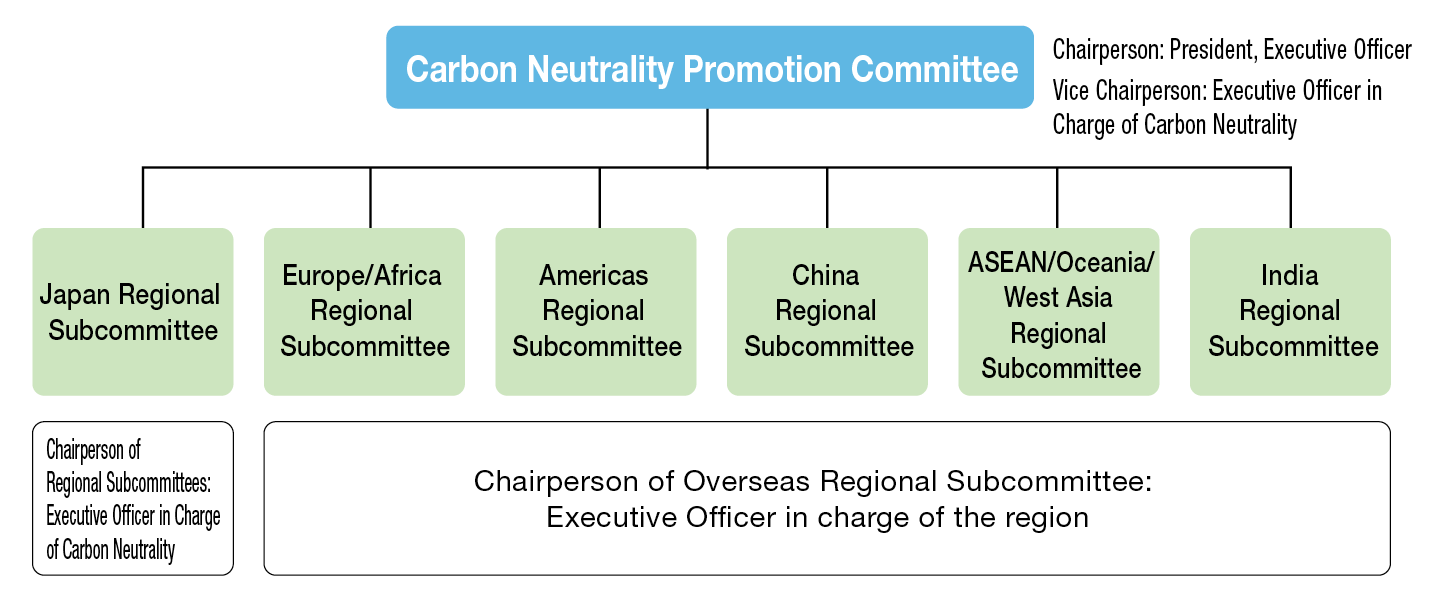
The NTN Group has established a system for the global promotion of activities toward achieving carbon neutrality. We have developed a global promotion system, with the Carbon Neutrality Strategy Promotion Department set up in April 2023, followed by the establishment of the Company-wide Carbon Neutrality Promotion Committee as well as regional subcommittees comprising members from the respective global regions in July. In January 2024, the second meeting of the Carbon Neutrality Promotion Committee was convened as a plenary session. At this meeting, the carbon neutrality roadmaps of each region, aimed at achieving the carbon neutrality targets, were gathered and summarized to create a global roadmap. Based on this global roadmap, we will steadily promote activities toward achieving our targets going forward.
■Carbon Neutrality Promotion System
Drawing up carbon neutrality roadmaps
The NTN group has set a carbon neutrality target and is actively promoting activities to achieve it. We have developed a carbon neutrality roadmap to serve as an indicator of these activities. In addition to a company-wide global roadmap, we have also created roadmaps for each Japan and overseas region, and we regularly monitor the progress of these activities.
■Carbon Neutrality Roadmap
Reduction measures for each scope
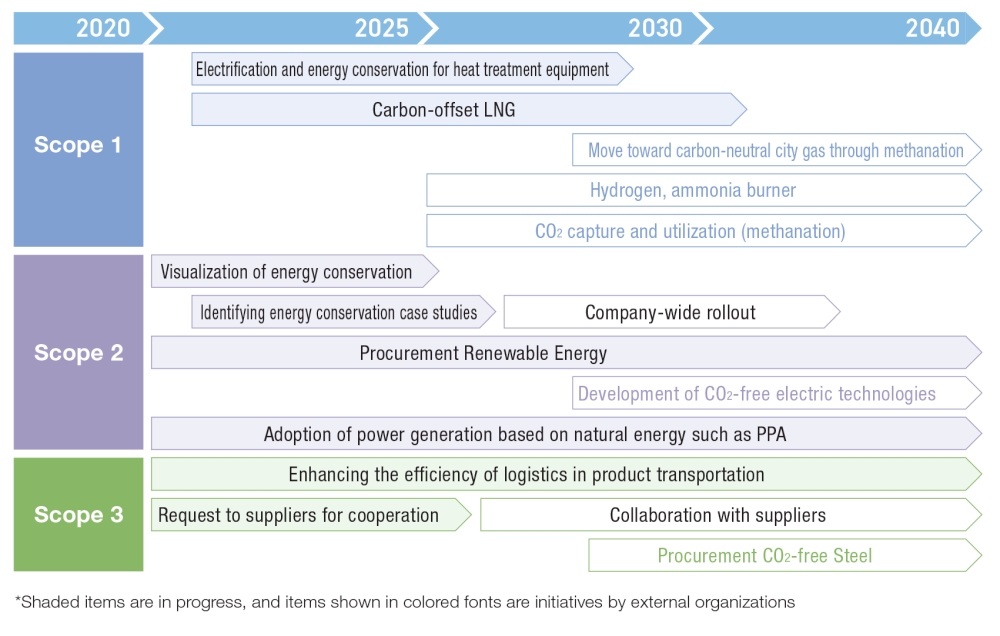
The roadmap provides an overview of the initiatives for reducing emissions under each scope. Alongside with promoting the activities for improving CO2 emission reductions internally, such as electrification, energy conservation, and adoption of power generation based on natural energy, we will also accelerate activities in partnership with external organizations.
■Initiatives for each scope
CO2 emission reduction track record and initiatives
Our Company’s Emissions (Scope 1 (Direct Emissions), Scope 2 (Indirect Emissions))
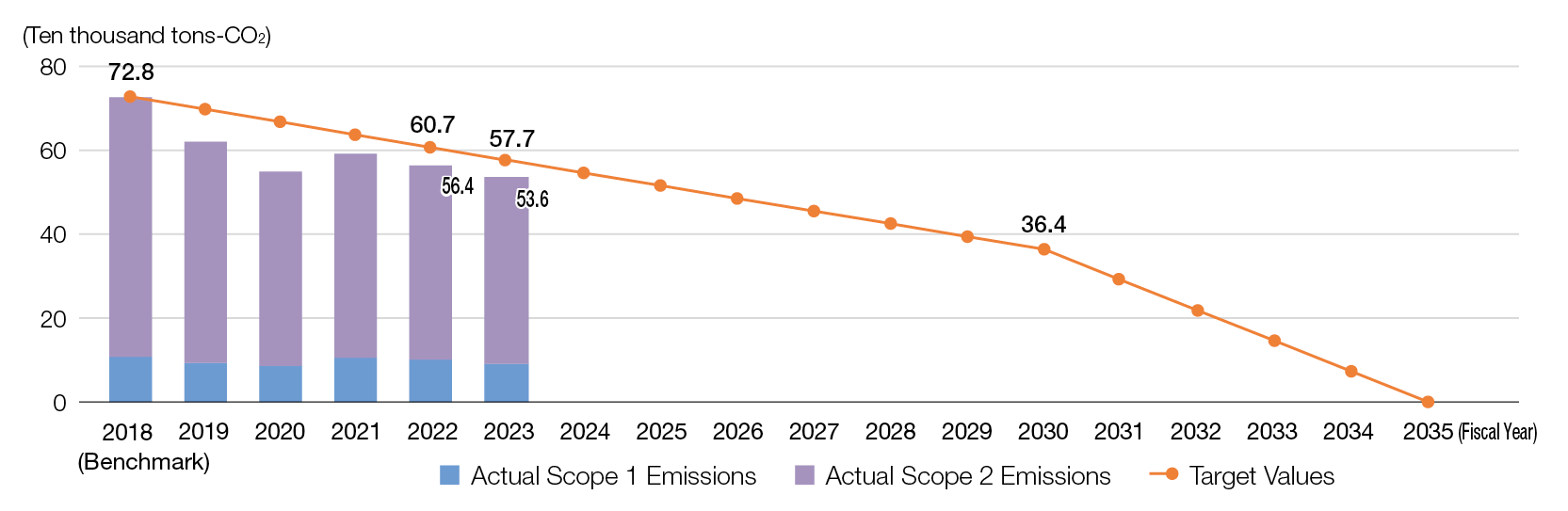
The NTN Group is working to achieve a 50% reduction in emissions by FY2030 compared to FY2018 and carbon neutrality by FY2035. The actual results for FY2023 are 90,943 tons for Scope 1 (50,591 tons in Japan and 40,352 tons overseas) and 445,425 tons for Scope 2 (219,669 tons in Japan and 225,756 tons overseas). Scope 2 emissions are calculated using market-based emission factors for Japanese sites and location-based emission factors for overseas sites.
■Scope 1 and 2: Actual Emissions and Targets
Examples of initiatives
Introducing examples of initiatives to reduce CO2 emissions
Energy Conservation Measures for Heat Treatment Facilities
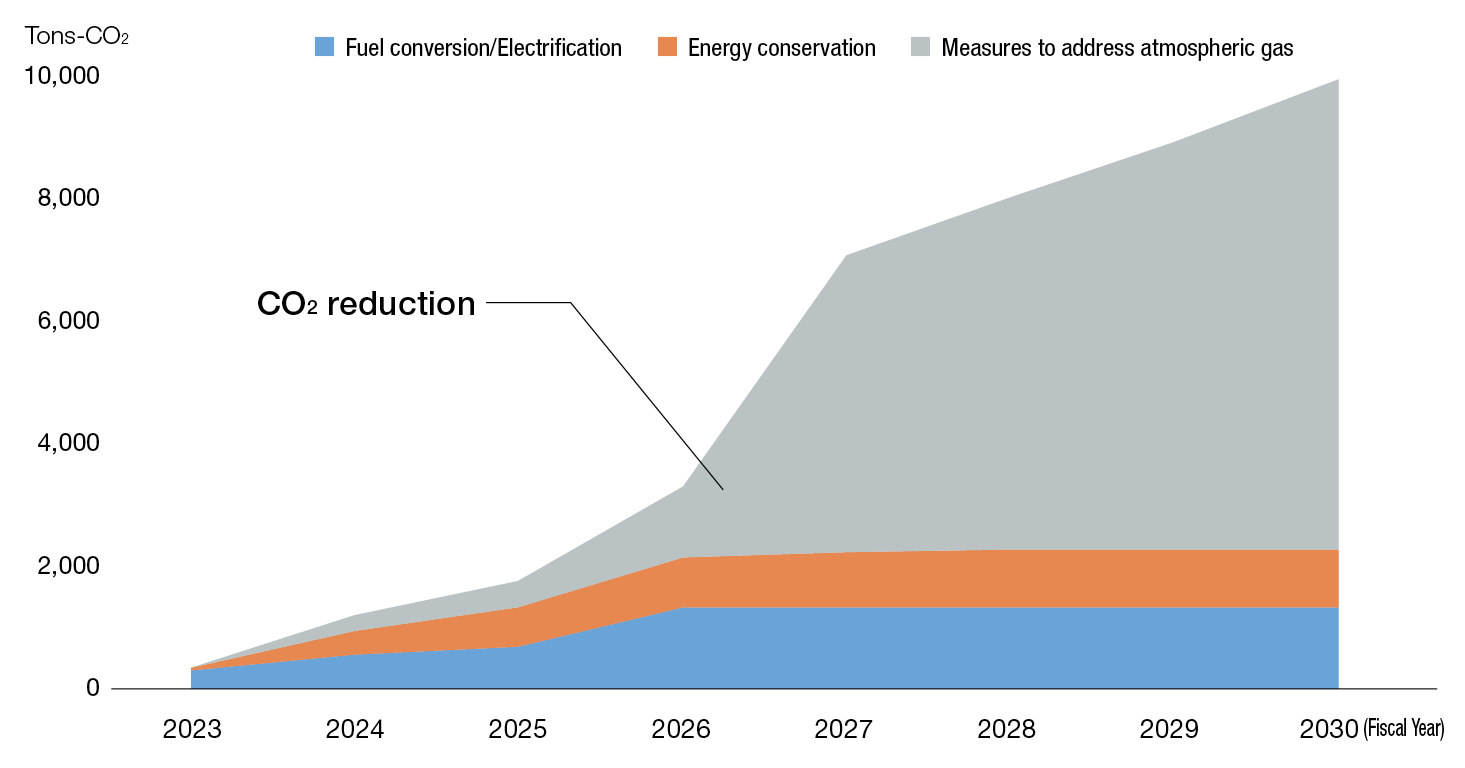
To reduce CO2 emissions from heat treatment facilities, we are promoting three measures: fuel conversion and electrification, energy conservation, and atmospheric gas control. All newly introduced heat treatment furnaces since 2017 are electric furnaces. Additionally, high-efficiency insulation materials have been introduced to minimize heat loss from the outer walls of the heat treatment furnaces, thereby reducing fuel consumption. Furthermore, we are reducing CO2 emissions through atmospheric gas countermeasures in furnaces dedicated to ordinary quenching.
■Energy-saving measures for heat treatment equipment
Example of initiatives at Wakayama Works
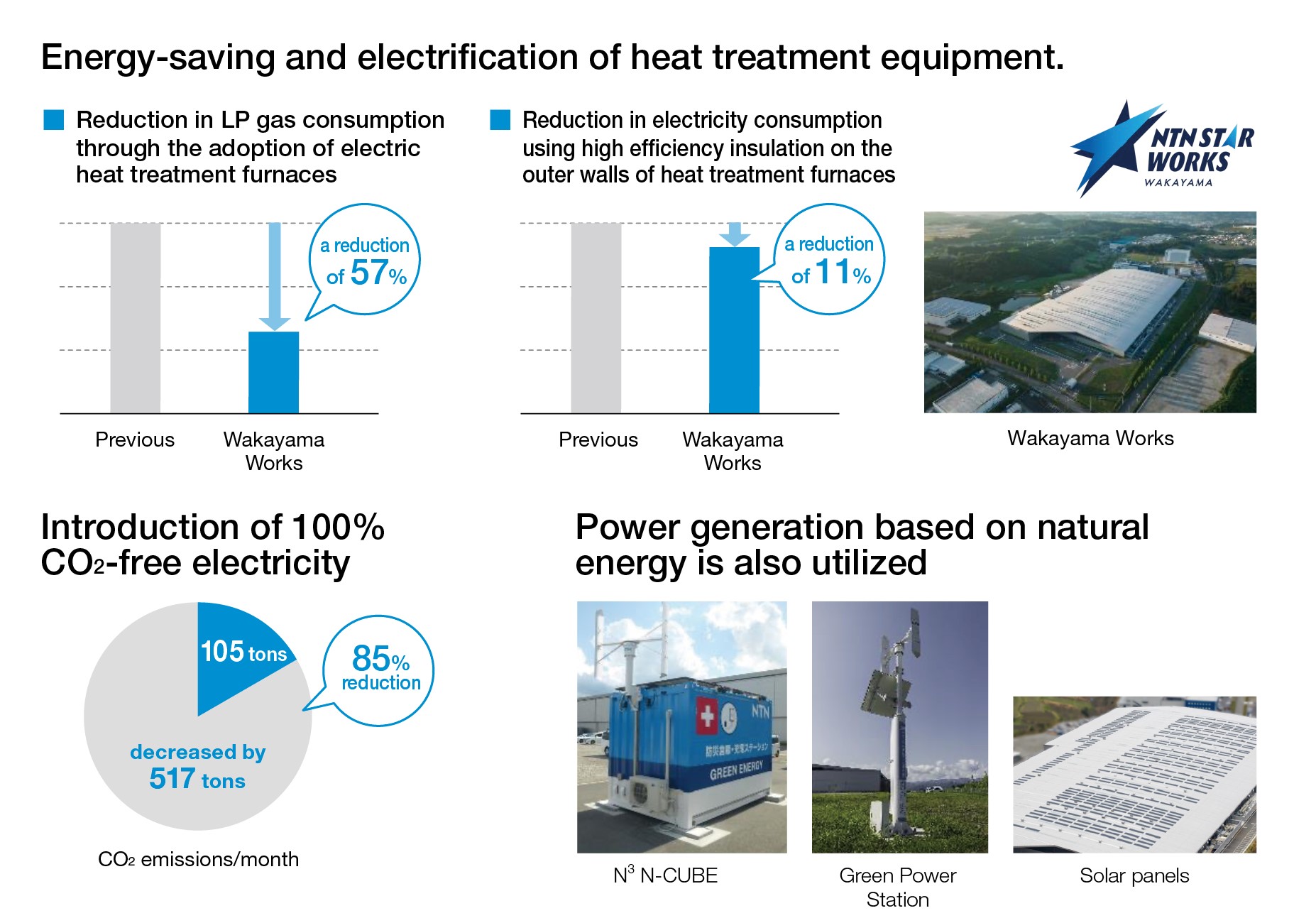
Wakayama Works, which commenced full-scale operation in FY2023, has implemented many initiatives. Electric furnaces have been introduced for all quenching furnaces to promote electrification toward reducing Scope 1 emissions. Furthermore, LNG consumption was also reduced by 57% in comparison with non-electric furnaces. To reduce Scope 2 emissions, high efficiency insulation was installed on the outer walls of the furnaces to reduce electricity consumption by 11%. In addition, by introducing carbon-free electricity for all the electricity used inside Wakayama Works, we have successfully reduced CO2 emissions inside the factory by 85%. Power generation based on natural energy is also utilized. NTN’s products, “N3 N-CUBE,” which combine wind power generators with solar panels in containers, as well as “NTN Green Power Station,” an independent power source that combines wind power generators and solar panels, are already in use, while solar panels have also been installed on the factory buildings.
■Example of initiatives at Wakayama Works
Visualization of electricity in production plants, and improvements to energy conservation
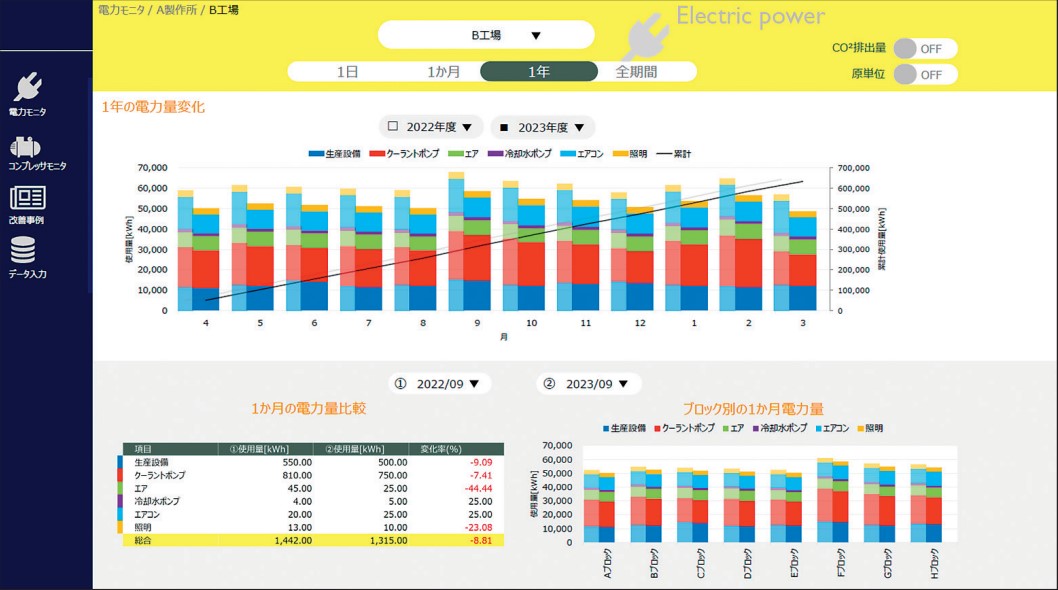
Approximately 80% of the company’s CO2 emissions are derived from electric power. We are promoting energy-saving measures by visualizing the electricity used for product processing within the appropriate range of manufacturing blocks and lines and prioritizing them. Not only the department in charge of carbon neutrality, but also related departments such as the Information System Department and the Production Engineering Department are participating in the study of specifications for a system to visualize power and air consumption in each manufacturing block unit at each plant, as well as the network within the plant. Effective energy-saving measures are compiled into a database and globally deployed not only in Japan but also at overseas sites.
■Energy visualization system (development concept)
Operation of internal carbon pricing (ICP) system
We consider internal carbon pricing (ICP) a mechanism necessary for achieving carbon neutrality. The NTN Group has introduced ICP from April 1, 2023, as an investment decision indicator for selecting economical facilities with low CO2 emissions.
Promoting the introduction of natural energy generation sources and the purchase of renewable energy-based electricity
Implementation results
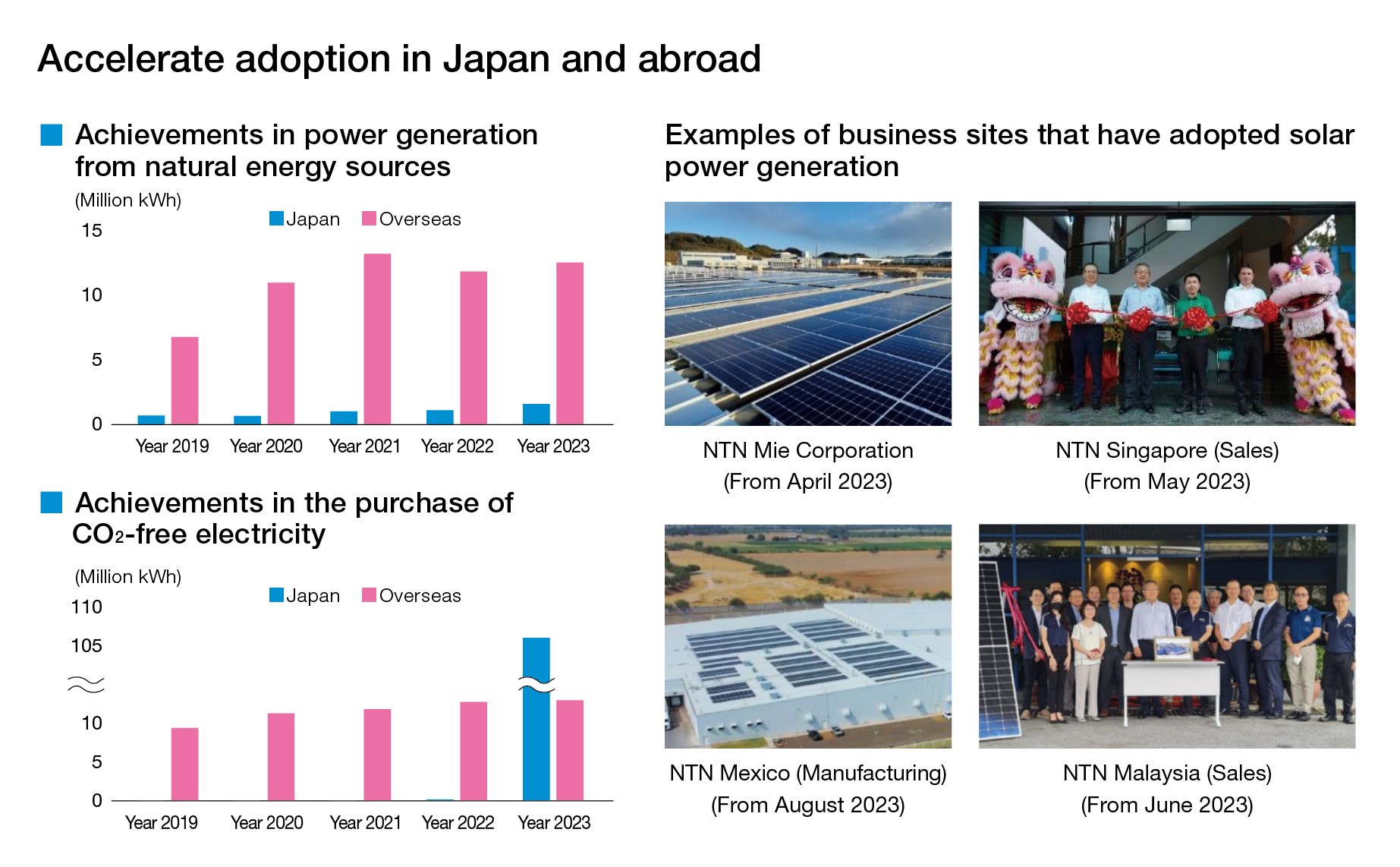
The NTN Group is working to reduce CO2 emissions (Scope 2) by installing on-site renewable energy power generation facilities at its business sites through various schemes (PPAs, leases, and self-investment). Additionally, we are actively promoting the procurement of renewable energy and carbon offset electricity through credits and other means. In fiscal 2023, we reduced CO2 emissions by 47,548 tons in Japan and 12,104 tons overseas.
■Natural Energy Generation performance (FY2023)
| Area | Amount of Electricity Generated (kWh) |
CO2 Reduction (tons-CO2) |
|---|---|---|
| Japan | 1,641,485 | 765 |
| Brazil | 5,400 | 1 |
| Mexico | 204,341 | 83 |
| Thailand | 584,879 | 272 |
| India | 4,944 | 4 |
| China | 11,739,348 | 7,153 |
| Total | 14,180,397 | 8,278 |
■Actual procurement of Renewable Electricity (FY2023)
| Area | Amount Procured (kWh) |
CO2 Reduction (tons-CO2) |
|---|---|---|
| Japan | 106,179,056 | 46,783 |
| Germany | 13,222,200 | 4,591 |
| Total | 119,401,256 | 51,374 |
Example of activities
While our business sites in China are leading the way in power generation through natural energy sources, other overseas sites are also making progress in the introduction of such power generation systems. In Japan, Kuwana Works was the first to introduce solar power in 2021 by utilizing PPA, and there are plans to install additional solar panels by FY2025. We are also considering installation at other factories and affiliated companies both in and outside Japan. While we began purchasing CO2-free electricity in Germany from 2020, some business sites in Japan have also begun doing so from June 2023. In FY2024, all manufacturing sites in Japan will be adopting CO2-free electricity.
■Promoting the introduction of natural energy generation sources and the purchase of CO2-free electricity
CO2 emissions from the supply chain (Scope 3)
The NTN Group’s goal is to achieve carbon neutrality, including supply chain emissions (Scope 3), by FY2050. Scope 3 calculations are made at our Japanese sites using the Input-Output table and IDEA (Inventory Database for Environmental Analysis) emissions intensity. Category 1, ‘Purchased Products and Services,’ which is the largest emission category among all categories, is mostly due to the procurement of raw steel materials and semi-finished products such as forgings, turned products, and other work-in-process products. In the future, we will improve our Scope 3 calculation method by reviewing the basic unit used, among other factors, and promote activities on a global basis to identify and reduce emissions in line with actual conditions.
■Emissions from the supply chain (Scope 3) [Japan]
(Unit: tons)
| Category | FY2022*1 | FY2023*1 | ||||
|---|---|---|---|---|---|---|
| Percentage | Year-on-year change | Third-party verification |
||||
| 1 | Purchased goods and services | 2,011,395 | 2,189,792 | 93.71% | 8.87% | ○ |
| 2 | Capital goods | 31,648 | 46,432 | 1.99% | 46.71% | ○ |
| 3 | Fuel and energy-related activities not included in Scopes 1 and 2 | 56,836 | 54,783 | 2.34% | -3.61% | ○ |
| 4 | Upstream transportation and distribution <Not applicable> | - | - | - | - | |
| 5 | Waste generated in operations | 16,192 | 16,905 | 0.72% | 4.40% | |
| 6 | Business travel | 1,290 | 1,285 | 0.05% | -0.39% | |
| 7 | Employee commuting | 4,687 | 4,667 | 0.20% | -0.43% | |
| 8 | Upstream leased assets <Not applicable> | - | - | - | - | |
| 9 | Downstream transportation and distribution*2 | 12,666 | 17,582 | 0.75% | 38.81% | ○ |
| 10 | Processing of sold products <Not applicable> | - | - | - | - | |
| 11 | Use of sold products <Not applicable> | - | - | - | - | |
| 12 | End-of-life treatment of sold products | 7,061 | 5,233 | 0.22% | -25.89% | |
| 13 | Downstream leased assets <Not applicable> | - | - | - | - | |
| 14 | Franchises <Not applicable> | - | - | - | - | |
| 15 | Investments <Not applicable> | - | - | - | - | |
| Total for categories 1 to 15 | 2,141,775 | 2,336,679 | 100.00% | 9.10% | ||
*1 Calculated using the emission factor set out in the “Emissions Unit Values Database for Accounting of Greenhouse Gas Emissions, etc., by Organizations Throughout the Supply Chain (Ver. 3.3)” (published by the Ministry of the Environment).
*2 The verification scope of Category 9 is limited to ‘Japanese logistics where NTN is the shipper.’
Partnership with suppliers, and enhancing logistical efficiency
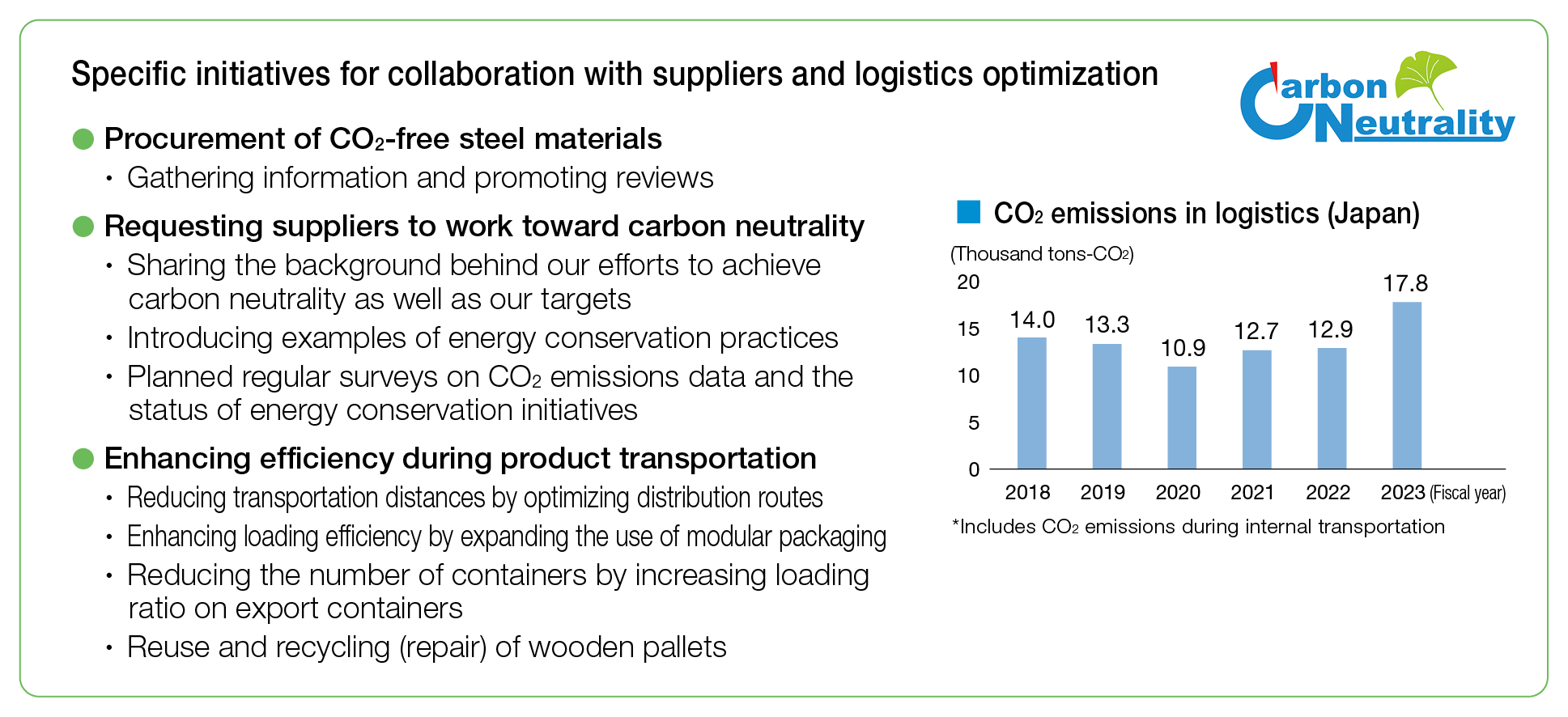
The NTN Group has established the target of achieving carbon neutrality, including emissions from the supply chain (Scope 3), by FY2050. In the future, we will gather information and conduct reviews toward procuring steel manufactured by using CO2-free electricity. During the briefing on our business policy in May 2023, we shared with suppliers the background behind our efforts to achieve carbon neutrality as well as our targets. At the same time, we are also rolling out activities to promote partnerships, such as by introducing examples of energy conservation practices. By working to enhance logistical efficiency, such as reducing transportation distances by optimizing the distribution routes, we are striving to reduce CO2 emissions during product transportation.
■Partnership with suppliers, and enhancing logistical efficiency
Participation in GX League
NTN participates in GX League, an initiative led by the Ministry of Economy, Trade and Industry since its inception. GX League was launched in 2023 as a forum for tackling green transformation (GX) challenges with a view to achieving social change and realizing carbon neutrality in 2050, facilitating industry-government-academia collaboration among companies that aim for sustainable growth, and engaging in discussions and practice to innovate the socioeconomic system and create new markets. Activities in the GX League began in earnest in 2024. As this initiative is aligned with the direction of NTN’s carbon neutrality activities, we have continued to participate in it, following up from our endorsement of the GX League Basic Concept in April 2022. Going forward, we will further accelerate activities toward achieving carbon neutrality, and cooperate with other participating companies and organizations through the GX League, in order to contribute to a carbon-free society and the creation of new opportunities for economic growth.
Sustainability Linked Loan
To accelerate efforts toward realizing a sustainable society through fundraising that is linked to sustainability activities, we concluded a Sustainability Linked Loan Agreement with the Norinchukin Bank in October 2023. With the support of Norinchukin Bank, we have drawn up a Sustainability Linked Finance Framework that sets out the performance targets (SPTs) linked to financing terms, as well as applicable interest rates, reporting, and other requirements. Under this framework, we have established, as SPTs, the progress status of interim targets toward the realization of the NTN Group’s decarbonization target (achieve carbon neutrality by FY2035 (including supply chains by FY2050). Going forward, we aim to achieve these SPTs and accelerate efforts to reduce CO2 emissions. Additionally, in the fiscal year 2023, we have also signed contracts with Meiji Yasuda Life Insurance Company and The Chugoku Bank, Ltd.
Internal training
The participation of all employees is vital in promoting carbon neutrality activities. For this reason, we conduct internal training on carbon neutrality to deepen understanding and stimulate employees. Furthermore, we regularly disseminate information on familiar topics related to carbon neutrality through the “Carbon Neutrality News,” and carry out activities to deepen understanding and interest. The news is prepared in Japanese and English and disseminated to overseas business sites. Overseas business sites utilize the news effectively, translating them to the local language and sharing them with local employees.
Third-party verification and opinions
We underwent third-party verification (SGS Japan Inc.) for our CO2 emissions in FY2023. It was confirmed that there are no issues with the calculation methods for Scope 1, 2 and 3, Categories 1, 2, 3, and 9.
■Third-party verification and opinions
| Verification and opinions | (PDF: 727KB) |
|---|