
NTN Develops CVJ Analysis Technology for Highly Accurate Prediction of Vehicle Vibrations
August 31, 2026

- Predicting the effects of CVJs on vehicle quietness and ride comfort at the design stage
- Reducing development person-hours by up to 8% and accelerating the development of high-value products
NTN Corporation (hereafter, NTN) has developed an analysis technology that enables vehicle-wide prediction of the effects of Constant Velocity Joints (CVJs), critical components that transmit power from motors and engines to the wheels, on vibrations during driving. This technology makes it possible to understand the effects of CVJs on vehicle vibration characteristics at the design stage and enables the development of new products optimized for specific vehicle characteristics. It also reduces development person-hours required for prototyping and vehicle testing, accelerates the development of high-value-added products, and contributes to the development of quieter and more comfortable vehicles.
In recent years, the spread of HEVs and BEVs has reduced engine-related noise and vibration, making vehicle-generated other noise and vibration more noticeable. As a result, demand for improved NVH (Noise, Vibration, and Harshness) performance, including a quieter cabin and ride comfort, has increased. In addition, the diversification of vehicle layouts, including powertrains and chassis systems, has increased the need to address different vibration characteristics among automobile manufacturers. At the same time, shorter development cycles and higher development efficiency have increased the importance of technologies capable of predicting the performance of individual components when mounted on a vehicle from the early design stage.
Among various CVJs, Tripod-type Plunging Constant Velocity Joints, commonly used on the differential side, transmit power while accommodating suspension movement. During operation, small axial forces generated by friction within the joint, known as induced thrust, can be transmitted to the vehicle body and affect vehicle vibration and ride comfort. However, it has traditionally been difficult to predict performance when mounted on a vehicle during the early stages of CVJ development, making repeated vehicle testing necessary for validation.
To address this challenge, NTN developed a vehicle vibration prediction and analysis model that combines its CVJ analysis technology based on mechanism analysis with transfer path analysis (TPA), which analyzes vibration transmission paths to the vehicle cabin. In its CVJ analysis technology, NTN enhanced its proprietary CVJ analysis model developed through years of experience, enabling more accurate reproduction of induced thrust generated during driving.
Furthermore, by analyzing vibrations transmitted from the CVJ to the vehicle cabin through components such as the engine, electric drivetrain units (e-Axles), suspension systems, and vehicle structural members (frames), while accounting for differences in the transmission characteristics of each component, NTN has enabled highly accurate prediction of vehicle vibrations during driving.
The new technology makes it possible to understand how vibrations are transmitted to the vehicle cabin through individual components and evaluate the performance of a CVJ when mounted on a vehicle at the design stage. In addition, because its effectiveness can be verified from the early stages of development, it enables the development of products optimized for specific vehicle characteristics. Furthermore, by making it possible to predict vehicle vibrations without prototyping or vehicle testing, the technology is expected to reduce development person-hours by up to approximately 8% compared with conventional methods.
Going forward, NTN will use this technology to expand its database of vibration characteristics for various vehicle models, with the aim of realizing a development process that significantly reduces the need for vehicle testing in the future.
NTN will continue improving the quietness and low-vibration performance of its CVJs while strengthening its ability to propose optimal solutions tailored to vehicle characteristics. NTN will also accelerate the development of products for Next-Generation Mobility, including electrified vehicles such as HEVs and BEVs, and contribute to the realization of a more comfortable and attractive mobility society.
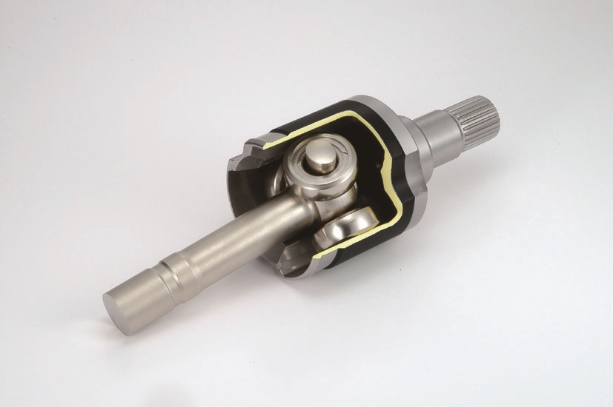 NTN's Tripod-type Plunging
Constant Velocity Joint “PTJ”
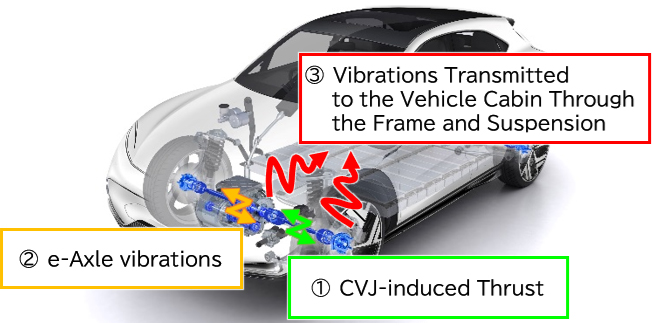 Transmission of Vibrations from
the CVJ to the Vehicle Cabin
NTN's Cyber Agile Engineering
NTN promotes “Cyber Agile Engineering,” an initiative that accelerates research and development through the active use of digital technologies such as simulation and data analysis in its R&D activities. By leveraging AI to enhance design, analysis, and evaluation in a digital environment, NTN is advancing development processes that are less dependent on physical prototypes and testing, helping shorten development cycles and improve development efficiency. This technology was also developed as part of these efforts.
NTN will further promote research and development utilizing digital technologies, enhance its capabilities for developing high value-added products, and contribute to the realization of a next-generation mobility society through the timely introduction of these products to the market.
Examples of development enabled by NTN's Cyber Agile Engineering
-
Press release on January 8, 2026:
Industry First! NTN Enhances Automotive Hub Bearing Design Efficiency through AI Integration
https://www.ntnglobal.com/en/news/new_products/news202500107.html -
Press release on December 17, 2025:
Contributing to Further Energy Efficiency of Automobiles! NTN Develops High-Accuracy Bearing Torque Calculation Method
https://www.ntnglobal.com/en/news/new_products/news202500109.html -
Press release on August 21, 2023:
NTN Develops Precise Remaining Useful Life Prediction Technology for Rolling Bearings
https://www.ntnglobal.com/en/news/new_products/news202300045.html
Inquiries about this release