Promote Safety and Health
Safety and Health Basic Policy
Ensuring the safety and health of all people working in the Group is the essential value that takes precedence over all business activities as the foundation of management, and based on this fundamental stance, we aim to “realize a workplace where employees can work safely and healthily.”
We have established our Safety and Health Basic Policy, with the following six items as its basic principles.
By presenting the policy to employees, shareholders, customers, business partners, etc., we will raise the safety awareness of our employees and organization and further enhance corporate value.
Outline of the Safety and Health Basic Policy
- 1. Compliance with laws and regulations
- 2. Promotion of continuous improvement through the operation of an occupational safety and health management system
- 3. Elimination and reduction of hazardous / harmful risks
- 4. Promotion of employee education and training
- 5. Maintenance and promotion of mental and physical health
- 6. Creation of a safety culture
Safety and Health Efforts
Under the Safety and Health Basic Policy, we will promote our safety and health activities, with the following three efforts as the pillars.
■3 Pillars of Priority Measures
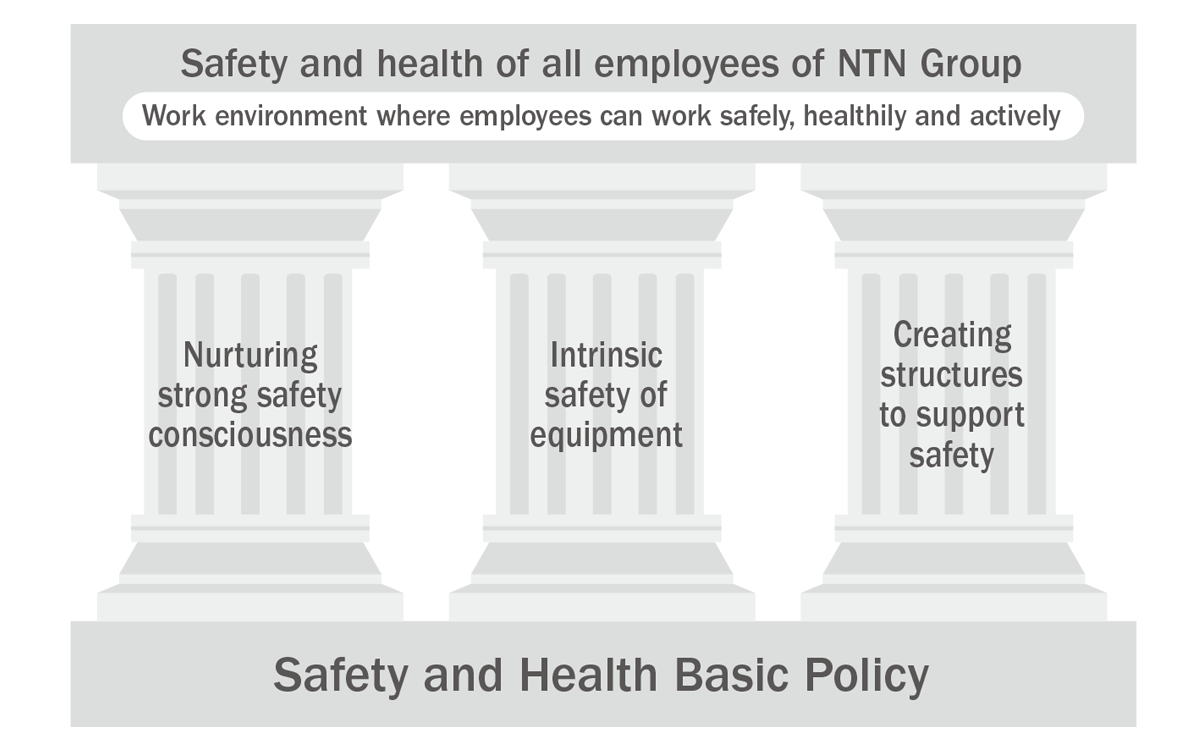
Nurturing Strong Safety Consciousness
We continually conduct hazard prediction (KY) training to improve safety awareness and to identify dangerous situations and conditions as hazardous. The training is divided into foundational and practical formats with a total of ten or more training conducted continuously throughout the year. In foundational KY training, we work to establish the foundations of KY and improve hazard sensitivity mainly for young employees and employees with little experience, while in practical KY training, we work to improve safety awareness throughout the workplace through training mainly for supervisors and veteran employees who have completed the foundational program, improving KY skills so that participants can serve as core drivers of workplace safety activities. Similarly, we conduct Risk Assessment (RA) trainer training ten or more times per year on a continuous basis. By having trainees participate in RA at their own workplaces, we implement RA on themes that align with the original purpose of RA (prevention of serious accidents). We also work to eliminate the causes of human error in order to create workplaces with good communication where employees can easily consult with others, while also strengthening the roles of foremen and safety promotion personnel, information transmission, and TBM (Tool Box Meeting).
Intrinsic Safety of Equipment and Operations
We continuously conduct risk assessments of dangerous “equipment” and “work” related to hazard sources, working to prevent serious accidents by reducing manifest and latent risks. In addition to engineering measures such as safety covers and interlocks for equipment, we implement safety measures for equipment and work through lockout/tagout promotion, management of procedures and rules, and protective equipment. We are also strengthening residual risk management on a Group-wide unified basis, promoting visualization of dangerous points for workers and when accidents occur.
Creating Structures to Support Safety
As part of creating systems that support safety for our Group, we are promoting the introduction of occupational safety and health management systems. By continuously operating these management systems and implementing PDCA cycles, we will work to ensure legal compliance and improve occupational safety and health standards.
We have completed certification for ISO 45001*1, an international standard, at all of our manufacturing sites.
Among 16 domestic manufacturing affiliated companies, 2 companies have completed ISO 45001 certification, 8 companies have completed JISHA-style OSHMS*2 certification, and 6 companies have completed GSC*3 evaluation. Currently, 2 affiliated companies are pursuing GSC evaluation. Five overseas affiliated companies have also acquired ISO 45001 certification.
When occupational accidents occur, we share information and implement horizontal deployment regarding the status and countermeasures for such accidents through occupational accident reports. When a lost-time accident occurs, or when multiple occupational accidents occur within the same workplace (section) during the fiscal year, we conduct safety audits for recurrence prevention, with audit members composed of safety personnel from other business sites.
We verify safety activities at the relevant workplace on-site and assess the effectiveness of the on-site safety management system.
For occupational accidents that have occurred, we also provide guidance to understand why the affected worker took such actions, identify the root causes, and link them to countermeasures.
- ISO 45001: International standard for occupational safety and health management systems
- JISHA-style OSHMS: Domestic standard compliant with the Ministry of Health, Labour and Welfare’s “Guidelines for Occupational Safety and Health Management Systems (OSHMS Guidelines)”
- GSC: Ministry of Health, Labour and Welfare’s Small and Medium-scale Workplace Occupational Safety and Health Evaluation Project (Good Safety Company)
Oversight of Occupational Safety and Health Risks by the Board of Directors
The Company positions the oversight of occupational safety and health risks within the Group as a responsibility of top management. The number of global lost-time occupational accidents and the progress of key initiatives are reported to the Board of Directors.
Create a Safe and Secure Workplace
Enhance Measures Against Fires, Natural Disasters, etc.
With the top priority being ensuring the safety of employees, we conduct annual general disaster drills against fires, earthquakes, etc. at each site, as well as regular independent training.
Risk surveys are also carried out regularly at manufacturing sites by risk consulting firms. By receiving objective assessment of the software and hardware measures in place against fires, natural disasters, etc., we are working to enhance these measures further.
In Japan, we have introduced a system for confirming the safety of employees following disasters. In addition, we conduct company-wide registration training annually and site-specific training as necessary to build a framework that enables us to confirm safety immediately, even in case of an emergency.
In the Crisis Management Headquarters Drill conducted in February 2026, which simulated a major earthquake, we also conducted drills using this system for the registration, aggregation, and reporting of safety confirmation information, thereby enhancing its effectiveness.