Outside Director Dialogue
~Cross-talk among Outside Directors and Executive Officers~
*This information is based on the content of the NTN Report 2025.
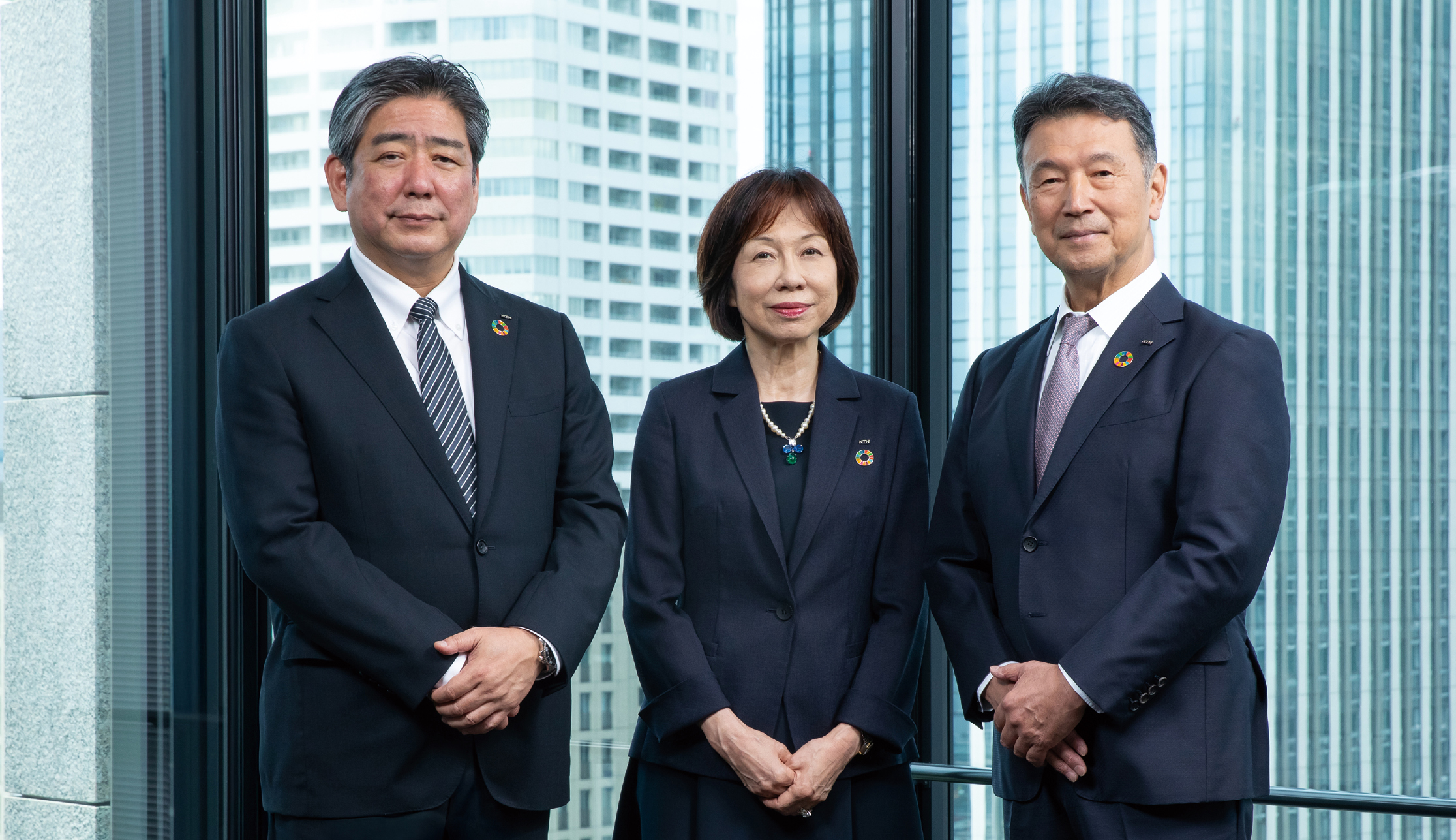
Executive Officer
Shumpei Kinoshita
Outside Director
Yuriya Komatsu
Outside Director
Tatsuhiko Toshita
Every year, the NTN Report provides an opportunity for Outside Directors to discuss NTN’s management and sustainability issues, publishing the content under the title, ”Outside Director Dialogue.” This year, we are presenting this as a “cross-talk” discussion among Outside Directors and Executive Officers featuring Board of Directors Chair Yuriya Komatsu, Director Tatsuhiko Toshita (appointed in June last year), and Executive Officer Shumpei Kinoshita, who is in charge of management strategy. They frankly discuss NTN’s current situation and challenges.
Review of the first year of the Medium-term Management Plan ”DRIVE NTN100” Final
- Kinoshita:
-
Looking back at the first year of the Medium-term Management Plan, to be honest it was a challenging start. Due to sluggish sales, we were unable to achieve targets related to operating income such as ROIC. Meanwhile, regarding the structural reform that incorporated 35 billion yen in special losses over three years, we streamlined production and reduced costs by consolidating or closing plants in Europe, China, and Canada ahead of schedule. While some adjustments became necessary due to changes in US trade policy, we plan to accelerate reorganization linking Japan and the US from FY2025. Actions to increase the aftermarket sales composition ratio mainly focused on developing large overseas markets, but were impacted by deteriorating market conditions due to factors such as Russia’s invasion of Ukraine. Inventory preparation and production capacity upgrades in Japan for aftermarket sales growth, as well as procurement of finished products from relevant overseas companies, are progressing and will continue to accelerate.
- Komatsu:
-
Regarding structural reform, I commend the employees for their persistent efforts, including stopping production ahead of schedule, even under conditions more severe than anticipated. However, it is also true that from the perspective of by institutional investors and other external stakeholders, there remain shortcomings in the speed and target-setting of reform. They expect us to establish a system capable of achieving financial indicators comparable to companies with best practice in the industry through thorough structural reform within approximately three years, and to become a company that can sustain growth and competitive advantage over the medium to long term (5-10 years). To avoid greatly disappointing these expectations, we need at least to set high internal targets and give daily thought as to how to achieve them. Of course, the unexpected will occur, such as the US situation, but we should anticipate that the unexpected will occur and consider and take measures accordingly. In that sense, we should shift our mindset from ”improvement” to ”reform.” If we set a target to halve inventory, for example, we should persist until we achieve it. If we speed up with such an attitude, results will follow.
- Toshita:
-
Since becoming a Director last year, I have visited the five major works around Japan and four Group companies adjacent to the works. At each site, I could see that employees were earnestly working on challenges such as inventory reduction. However, I also got the sense that their thinking remained confined to their own areas of responsibility. To advance reforms, it is necessary to change the level of consciousness of each individual. Even when people are aware of targets, habitual ways of thinking do not change easily. I felt that even though people at the sites understood the situation, they were grappling with the dilemma that their daily actions were not effectively leading to success. As a result, key indicators other than inventory turnover ratio declined compared to last year.
- Komatsu:
-
I believe employees are working hard. However, from the perspective of ROIC and other indicators, targets have not been achieved, so employees may not feel they are contributing. To change the situation, I would like to see more examples of actively promoting people who boldly take on challenges. For instance, giving opportunities to young people with a growth mindset who are going to pursue efficiency through digital transformation, and rewarding them with bonuses and promotions if they succeed, and hailing their initiative even if they fail. If we motivate people with clear evaluations linked to the personnel system, we can expect acceleration.
- Kinoshita:
-
With the aim of speeding up, we overhauled the business headquarters system and made a major change to a product-based system of CVJ & Axle and Bearing. At the same time, we revised the decision-making authority and target KPIs of Executive Officers for each region and business, strengthening the authority and responsibility of Executive Officers responsible for a business globally along vertical lines including sales, profit, inventory, and policy measures. The progress in inventory reduction this time was due to the policy measure puzzle pieces starting to fall into place that manufacturing, production management, and production engineering departments had been working on, such as production reforms, production volume adjustments, and domestic and international logistics changes. To these we can add the improved coordination between domestic and overseas sites through these organizational changes. However, employee mindset transformation is incomplete, and regarding the utilization of young people, as you pointed out, we will continue to work consciously on this.
Effectiveness of corporate governance
- Kinoshita:
-
Regarding corporate governance, we incorporate ESG into the target management of all Executive Officers and make it subject to evaluation. However, regarding the points you mentioned earlier about key indicators other than inventory reduction not being achieved and setting targets higher, we will consider taking another step forward from a governance perspective as efforts to raise our sights and change habitualized consciousness.
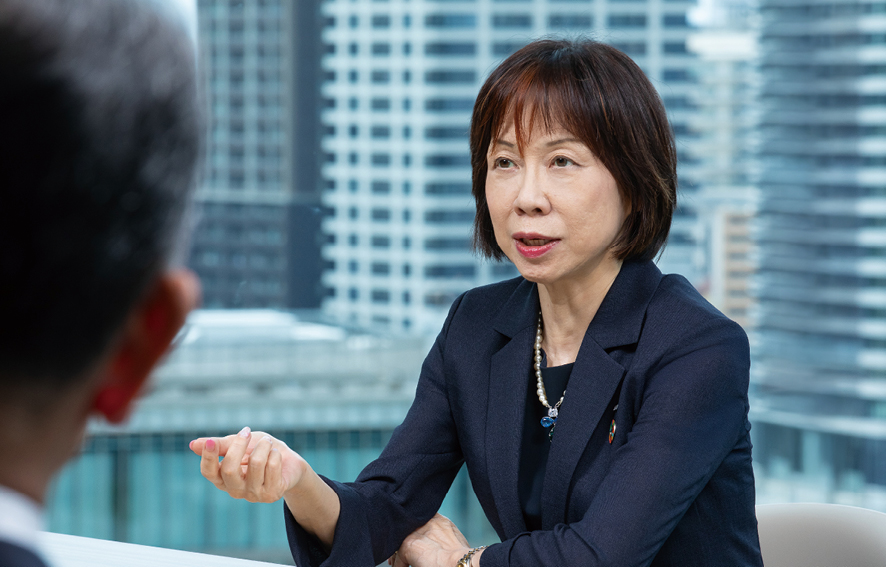
- Komatsu:
-
Regarding the effectiveness of governance from a compliance perspective, rules are properly established and monitoring systems have improved. I understand that we are currently working on further improvements to strengthen monitoring of governance at domestic and overseas affiliated companies. Another important issue is personnel evaluation at overseas subsidiaries. Rather than managing under instructions from the parent company, I want subsidiaries to undertake reforms and improvements themselves and raise their management level. I think particularly for large subsidiaries in the United States and Europe, which have significant impact on our Group performance, it would be good to thoroughly implement a system where local management proactively undertakes reforms and improvements, with the parent company supervising and evaluating them, with clear rewards and punishments, and replacing management if results are not achieved.
- Toshita:
-
Since the challenges are fairly clear at this point, I expect initiatives with even greater speed. While Group subsidiaries are distributed across Japan, Europe, and the United States, each with their own unique circumstances making it highly complex, we should set priorities according to risk level and focus resources. As a manufacturer, plant equipment relocation and product changeover take time. That is precisely why we need an approach of predicting major changes in business conditions and preparing in advance. Something else that preoccupied me when visiting sites was that the labor population decline problem is on our doorstep. Considering the changes in employee age composition that will become apparent in five years at NTN as well, I think we should implement countermeasures with fresh thinking.
- Kinoshita:
-
To change the mindset including at NTN subsidiaries, we started ”halving activities” worldwide in FY2025. For companies like ours with many product types and a global footprint, reforming the cost structure requires not only major structural reform but also a whole lot of reforms down to operational details, heeding suggestions from everyone involved. We ask employees to discover inefficiencies and waste in their workplace, and to work on ”halving” or ”doubling efficiency” even for small matters. We expect this campaign to produce not just small improvements but a wave of reform, and like inventory reduction, become a force that brings us closer to targets as the puzzle pieces fall into place. Regarding personnel evaluation and development of top leadership at subsidiaries, we are utilizing these posts as tough assignments and positions for developing next-generation management, and believe approaches from the perspective of medium- to long-term succession planning are also necessary.
- Toshita:
-
Regarding succession planning, it might be necessary to switch perspectives depending on whether it is an emergency or not. For example, in an emergency, would it not be an option to call on those who have retired, such as the alumni networks that have been attracting attention recently? In normal times, as you explained, we want candidates to experience new value creation and growth through difficult challenges. The company’s attitude as reflected in numbers is also important, and while research and development expenses as a ratio to sales are at levels comparable to competitors, I think we should also be conscious of the amount invested in equipment, for example. While the future is increasingly uncertain, we need to prepare for various situations so that we can immediately take action when the environment changes.
- Komatsu:
-
Regarding management leadership, external recruitment for loss-making companies is also an option. In structural reforms to make a company profitable, it is important to consider a wide range of talent, not limited to those with industry experience. If the two large subsidiaries in the United States and Europe were to turn profitable, it would completely change our business performance. If we can reduce assets, ROIC will also change. I want NTN to work with strong determination to accelerate reforms, enhance profitability, and achieve V-shaped recovery as early as possible.
- Kinoshita:
-
Regarding succession planning, we are working both on rejuvenating overseas general managers and developing next-generation management. I understand that urgency is also needed here. Particularly for restructuring in Europe and the Americas, which we want to achieve as soon as possible, the CFO will be in charge of the European region and I will be responsible for the Americas region from this fiscal year, working together with local top management to accelerate matters. Additionally, one Executive Officer will be dedicated to the project, establishing a system where regions collaborate on production reorganization.
Strengthening the foundations for growth
- Kinoshita:
-
Production reform, procurement reform, logistics reform, and design domain reform will accelerate execution speed together with ICT reforms and generate results early. I recognize that structural reforms are not goals but means, and how to connect structural reforms to value creation and growth is important. Digitalization is also a major theme, and we have completely eliminated our host computers in Japan and switched to a new core system, enabling rapid business processing including producing estimates. We have also introduced model-based development utilizing our own systems, establishing a system that can promptly provide proposals with design simulations in response to customer requests. Closer to home, Executive Officers themselves have started new initiatives such as using AI to create meeting minutes and rapidly share information with stakeholders.
- Komatsu:
-
Such digitalization should be actively publicized. This is my personal impression, but I feel that DX has not progressed much at Japanese manufacturing sites. It is inevitable that DX and AI use initiatives will advance in all aspects. If these are initiatives that other companies are not pursuing, I think they would greatly benefit our IR efforts.
- Toshita:
-
The most pressing issue for our company is surely information utilization at our plants. We should comprehensively organize and utilize data necessary for production reforms, data leading to sales growth, and plant data essential for aftermarket business expansion. I think we should speed up building such systems.
- Kinoshita:
-
After advancing computerization, what will ultimately become the power to beat the competition is technology in the broad sense including manufacturing, procurement and logistics, and the people who make it possible. We need to develop people who create our company’s value, accurately convey it to customers, and promote our advantages. We will focus on ”developing people who set us apart from our rivals” as a long-term and global challenge.
Toward achieving the Medium-term Management Plan targets
- Kinoshita:
-
Finally, please give us advice on achieving the targets in the Medium-term Management Plan.
- Komatsu:
-
What I would say as an Outside Director looking toward the second year of the Medium-term Management Plan boils down to this: set high goals and follow through. From the perspective of shareholders and other stakeholders, I believe it is important to steadily advance structural reform without pause, even under severe business conditions. In that sense, my impression from visiting NTN plants was that there is plenty of room for efficiency improvement.
- Toshita:
-
Structural reform is a means to (1) create a corporate structure resilient to changes in business conditions and (2) improve ”earning power” as stated in the Medium-term Management Plan. It is not a goal. Mindset transformation is most important for structural reform, and without this, it remains ”improvements” on the conventional approach, not reform. Since changing a corporate culture is not easy, management must consistently advocate for it. Ultimately, companies change as a result of employees acting autonomously. For example, what would happen if inventory reduction were one of the most important themes, then a supervisor blamed their staff member for a stock-out due to unforeseen circumstances? That person would unconsciously move toward increasing inventory. Instead, if we allowed the use of air freight for delivery in case of unexpected situations for example, this would demonstrate how seriously the company took the situation. Delivering good products on schedule is fundamental for a manufacturing company, and I feel this important corporate culture is sufficiently developed. Precisely because of this, I hope that while protecting this corporate culture, we can review existing mindsets and common sense to enable endeavors for further value creation.
- Kinoshita:
-
When customers say, ”please deliver tomorrow,” we push ourselves to manufacture and deliver. Or when they say, ”we won’t buy unless it’s this price,” we strive to reduce costs to somehow match it. Such a culture has taken root in our company. In recent years, we have shed light on the problems arising from such stances. Of course, this is not at all about not valuing customers, but reconsidering what we need to do for our company to survive. As a result, we are more energetically engaging in price negotiations than before and not letting products remain unprofitable. This is a major shift from our traditional sales approach, but the spirit to carry this through is beginning to take root among employees. Particularly for the CVJ & Axle Bearing Business, which has one-to-one relationships with customers, the shift to reduce unprofitable model numbers and eliminate wasteful inventory is progressing quickly. For the Bearing Business, which supplies various products to diverse industries, negotiations and transitions are not easy, but things are definitely beginning to progress.
- Toshita:
-
Indeed, the Bearings business serves customers across diverse industries, so a uniform approach is difficult. For example, investigating the customer track record and narrowing down model numbers that can be provided would not progress easily if left to sites. How to judge potential negative impacts and how far to take action considering effects extending to suppliers and procurement requires management decisions. To repeat, what determines the success or failure of reforms is changes in mindset and behavior of each manager and employee. We need to simultaneously build a mechanism to visualize these changes. For example, regarding the aftermarket, we have set a target of 40% sales ratio by FY2035, but how about showing in a visual way the intermediate milestones to people inside and outside NTN?
- Kinoshita:
-
Simply put, there are two elements to increase aftermarket sales: riding market growth itself and gaining market share from competitors. Since market growth is not significant currently, to increase sales, we need bold and clever actions and mechanisms that lead the sector in terms of customer service and strategy. We are concentrating on reducing non-aftermarket inventory while focusing on the necessary inventory lineup. As part of strengthening business axes, since April 2024, we have set KPIs such as profit, inventory, and ROIC in a matrix of regions and businesses, and shared these with Executive Officers and regional general managers. While establishing this approach, we will proceed with inventory reduction and plan-versus-actual management of business plans.
- Toshita:
-
Such movements should be monitored constantly and updates disseminated throughout the company. I hope that NTN will actively disseminate information about growth investment plans that lead to improved employee motivation and continue steady progress toward achieving Medium-term Management Plan targets.
- Komatsu:
-
I also spoke with chief manager and above about the importance of ROIC and improvement measures when visiting sites, and I want to continue constructive suggestions by gathering information about employee motivation. One more point is that from the perspective of women, I intend to support the development of female talent aiming for management positions by establishing discussion forums with female employees at each site.
- Kinoshita:
-
Thank you very much for your valuable suggestions. We are dedicated to the ”revitalization of NTN,” never slowing the pace of reforms.
Message from our new Director
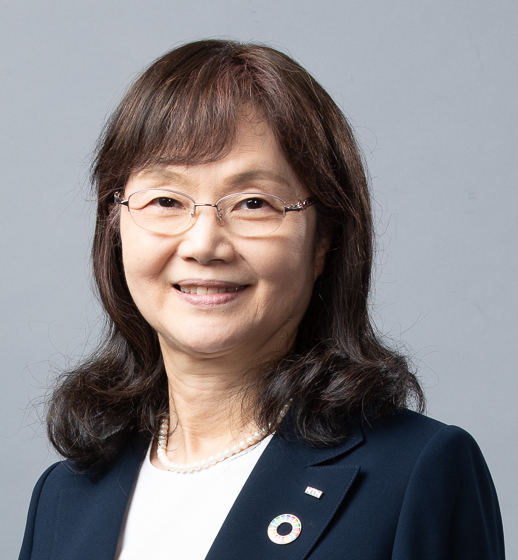
Outside Director
Hiromi Wada
After graduating from university, I joined a major electronics manufacturer and worked in the fields of research and development, product planning, and quality control across some four decades. In particular, my experience in developing i-Mode mobile phones and in-vehicle infotainment systems, developing products focused on the user perspective, has become the foundation of my career. Since retirement, I have served as a non-executive Outside Director at several companies and have been involved in important management decisions such as making structural reform, launching new businesses, and making decisions on withdrawing from markets. Through these experiences, I have developed an approach of contributing to corporate value enhancement from both a technical and a business perspective. I feel there is great potential in NTN’s technological and global expansion capabilities, and I will endeavor to contribute to its sustainable growth by combining grassroots awareness and management perspective from an external standpoint. Thank you very much for your support.