CSR activities in FY2023
Initiatives for TCFD recommendations
In May 2021, the NTN Group pledged its support for the TCFD (Task Force on Climate-related Financial Disclosures) recommendations. We identify the risks and opportunities that climate change brings to our business and reflect them in our sustainability activities. By engaging in dialogue with a wide range of stakeholders, the Group will further strengthen efforts to address climate change and contribute to the sustainable development of society through our business activities.
Governance
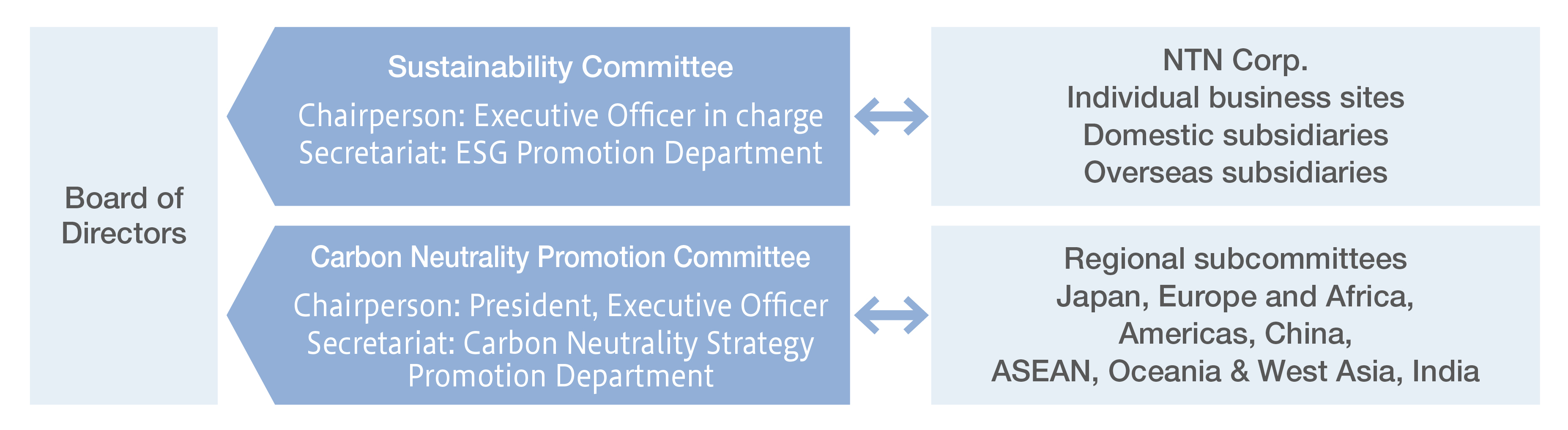
The Group has established the Sustainability Committee as a body that deliberates the sustainability activities required for identifying and resolving issues with a view to realizing a “NAMERAKA Society.” In FY2023, the Carbon Neutrality Promotion Committee was established to promote, more strongly and globally, efforts to achieve carbon neutrality, which is positioned as one of the issues toward the realization of a “NAMERAKA Society.” The Carbon Neutrality Promotion Committee formulates action plans for achieving the carbon neutrality target, and promotes the initiatives needed for achieving the plans.
Strategy
Responses to the risks and opportunities assumed from the scenario analysis results, in line with the TCFD recommendations, are applied to business activities as measures for related materialities such as “Reduce energy loss” and “Respond to climate change.” In addition, we concentrate our R&D resources on areas that lead to “carbon neutrality (environmental impact reduction and decarbonization)” and the “pursuit of safety and comfort” and are accelerating our R&D activities for future growth.
Risk management
Our financial condition, results of operations and cash flows could be impacted by extreme weather conditions (such as shutting down operations and businesses due to heavy rain, floods or storms) associated with climate change (temperature increases), and by stricter environmental regulations (such as increased procurement costs for raw materials and energy due to the introduction of carbon taxes) in the countries and regions in which we operate.
Regarding the effects of climate change (temperature increases), the risks and opportunities assumed based on the scenario in which the temperature rise during the 21st century is “4 °C” and “less than 1.5 °C” are as follows.
■Outline of the future vision assumed in scenario analysis
| When the temperature rises by 4 °C (Physical) |
When the temperature rises less than 1.5 °C (Transition) | |
|---|---|---|
| The future vision assumed |
|
|
■Risks and Opportunities
| Classification | Anticipated risks and opportunities | Our countermeasures | Related materiality | |
|---|---|---|---|---|
| Risks | Physical | Downtime at our plants and within the supply chain due to extreme weather conditions (heavy rain, floods, storms) |
<Internal>
|
|
| Risk of heat stroke among employees at plants and such |
|
|
||
| Transition | Increase in procurement and operating costs due to carbon taxes, etc. |
|
|
|
| Opportunities | Physical | Increase in demand for solutions that are useful in preparing for natural disasters and in the event of disasters |
|
|
| Transition | Increase in demand for energy saving in mechanical devices |
|
|
|
| Spread of wind power generation equipment |
|
|
||
| Spread of hydrogen energy |
|
|
||
| Spread of EVs and electrified vehicles |
|
|
||
Metrics and targets
Among the 13 materiality items, “Achieve carbon neutrality by FY2035 (by FY2050 for the entire supply chain)” has been set out as the long-term target for the item “Respond to climate change.” We have also established “50% reduction in CO2 emissions in business activities in FY2030 compared to FY2018” as a KPI (management indicator) for FY2022 and beyond.
The actual CO2 emissions of the NTN Group are as follows.
| FY2018 results (base year) |
FY2022 results |
FY2023 results |
|
|---|---|---|---|
| CO2 emissions (ten thousand tons) | 72.8 | 56.4 | 53.6 |
For FY2023, CO2 emissions were reduced by about 26% compared to FY2018 (the base year), indicating that we are progressing as planned toward achieving our long-term target. In April 2023, we established the Carbon Neutrality Strategy Promotion Department as a dedicated organization for promoting carbon neutrality, with the aim of strengthening the promotion of various measures that are necessary for achieving our long-term target.