CSR activities in FY2019
Climate-change Response
Energy-saving effort
In order to reduce CO2 emission from its production activities, the NTN Group has set CO2 reduction targets throughout all the group companies and at each business site and we are focusing on energy-saving of utility equipment such as compressors, air conditioners and lighting as a large-scale energy-saving measure and are working on daily energy-saving activities such as adopting inverter motors, taking measures against air leaks, and turning off the power of non-operating equipment in a steady manner.
In order to promote this, we introduced the "Warashibe Budget" from FY2016, which specializes in capital investment for CO2 reduction. This is our unique system that allows us to utilize the energy costs reduced by our Energy-saving efforts as the budget for the next fiscal year, and we are working on autonomous CO2 reduction activities through ingenuity at each business site.
NTN-SNR(Europe)
Use of waste heat by heat pump
In 2016, NTN-SNR introduced an Energy Management System (ISO50001) at seven plants to improve energy performance. Since 2016, we have been carrying out activities to identify energy loss in production facilities that use electricity and fuel. As a result, we have found that a large amount of heat loss has been occurred in compressors, cooling tower systems, and boilers, and we have been implementing energy conservation measures through the use of waste heat.
NTN-SNR was able to reduce fuel consumption by 2.7% by introducing heat pumps that utilize waste heat from cooling towers in boilers at the Seynod Plant (France), Argonay Plant (France) and the Sibiu Plant (Romania).
■Diagram of the a heat pump system

NTN-Bower Hamilton (U.S.A.)
Reducing energy consumption by installing air conditioning units on an indoor floor.
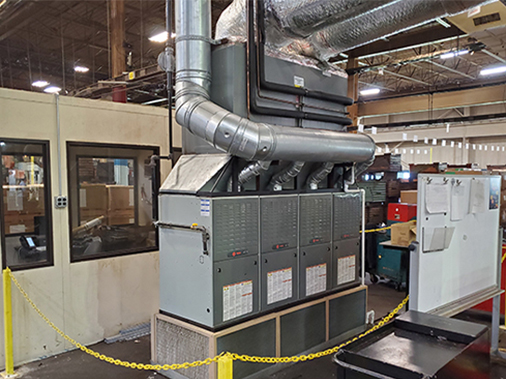
NTN-Bower Hamilton Plant replaced its roof-mounted air-conditioning unit with an indoor floor-mounted air-conditioning unit. The floor-mounted air-conditioning unit enables air to be sent efficiently to locations where temperature adjustments are required, reducing about 53 tons /year CO2 emissions at the entire plant compared to a roof-mounted air conditioner.
■Indoor floor-mounted air conditioning unit
NTN-RAB (Changzhou) Corp. (China)
Energy saving by installing air compressor intake duct
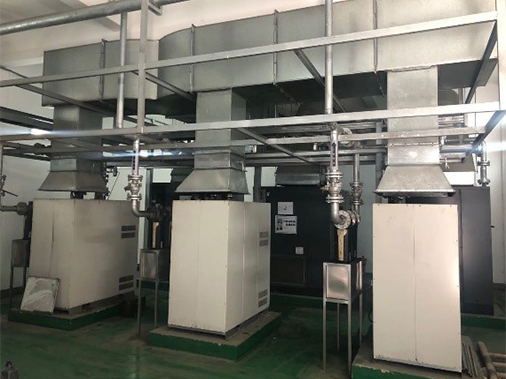
NTN-RAB Corp. installed an outside air intake duct to the air compressor to prevent sudden shutdown due to rising machinery temperatures in the summer and improve efficiency. By sucking and compressing low-temperature outdoor air, we were able to reduce energy consumption by about 2% and 17.9 tons/year CO2 emissions.
■Air intake duct for compressor
IWATA WORKS (Japan)
Conversion of fuel for surface treatment boilers (from heavy oil A to LPG)
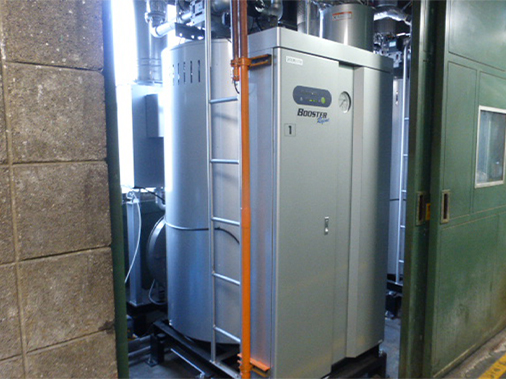
Iwata Works carries out surface treatment (Bonde processing) as a pretreatment for the forging process of automotive components. In this process, the waste heat generated in the plant is used after being further heated by a boiler fueled by heavy oil A. To further conserve energy by switching fuels, we have recently switched to higher efficiency boilers that use LPG. This has resulted in an improvement in boiler efficiency from 90% to 97%, reducing 209-tons/year CO2 emissions. Fuel conversion also reduced the amount of substances subject to PRTR (mainly methylnaphthalene) contained in heavy fuel oil A, resulting in a reduction in environmental impact.
■Boiler for Bonde processing
Switching to LED lighting
The NTN Group has made energy-saving investments to promote the use of LED lights at its business sites in Japan and overseas. In the fiscal year ended March 2011, we replaced 1,217 mercury and fluorescent lamps in Japan and 1,127 mercury and fluorescent lamps overseas with LED lights.
Initiatives for Introducing Renewable Energy
Power generation results of solar power and wind power
The NTN Group has installed renewable energy generation facilities within business sites and are using the generated power within business sites. In the fiscal year ended March 31, 2021, we are working to reduce CO2 emissions by generating renewable power of 620,623 kWh/year (236 ton-CO2eq/year) in Japan and 7,950,724 kWh/year (3,957 ton-CO2eq/year) overseas.
Nanjing NTN Corporation(China)
Introduction of solar power generation facilities in business sites
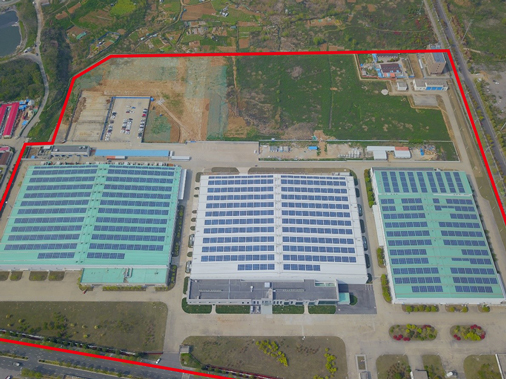
Nanjing NTN Corporation has installed a total of 14,000 solar panels on the roof of the factory. They have been in operation since January 2020 and are expected to generate 3.7 million kWh/year, reducing CO2 emissions by 2,722 tons/year.
■Solar panels installed on the roof (the inside of the red frame is the business site)
NTN-Antriebstechnik G.m.b.H. (Germany)
Switching to electricity from renewable energy sources
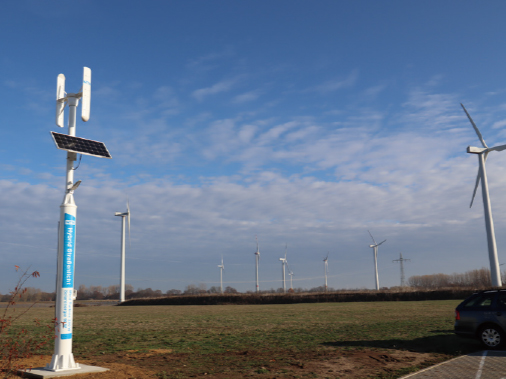
NTN-Antriebstechnik G.m.b.H.(NTN-AT) is located in the state of Sachsen Anhalt, Germany, where there are many wind turbine facilities and where renewable electricity is easily procured. With regard to electricity used on-site, NTN-AT has switched to renewable-energy-derived electricity since April 2020. This is expected to reduce CO2 emissions by approximately 6,000 tons/year.
The NTN Group is working to increase its renewable energy procurement rate by not only introducing solar and wind power generation facilities within business sites but also considering switching to renewable power sources.
■NTN Green Power Station (front) installed in NTN-AT and wind turbines facility of the electric power company
CO2 Emissions/Emissions Intensities
Own emissions Scope 1 (Direct emissions), Scope 2 (Indirect emissions)
■CO2 Emissions/Emissions Intensities (Japan)
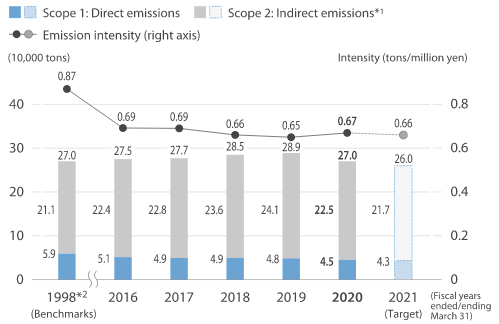
*1 Calculated using a fixed CO2 emissions factor of 0.381 kg-CO2/kWh for electricity in Japan.
*2 For business sites that were established in the fiscal year ended March 31, 1998 or later, will be set the data in the year of commencement of production is to be used as the benchmark.
■CO2 Emissions/Emissions Intensities (Overseas)*1
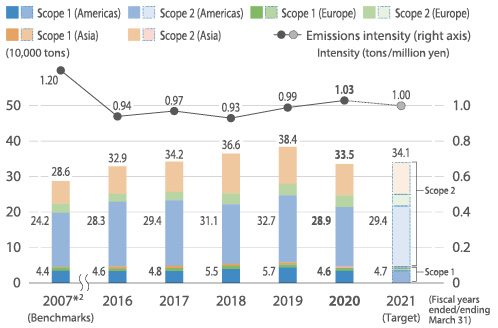
*1 Please refer to Environmental Targets: Business Sites with Performance and ISO14001 (2015 version) Acquisition Status for the target business establishments for CO2 Emissions/Emissions Intensities(Japan/Overseas)
*2 For business sites that were established in the fiscal year ended March 31, 2007 or later, the year of commencement of production is to be used as the benchmark.
Supply Chain Emissions (Scope 3)
| Category | Fiscal Year Ended March 31, 2020 | |||
|---|---|---|---|---|
| Third-party verification*3 | Emission (thousand tons-CO2) | Percentage of total | ||
| 1 | Purchased goods and services | ○ | 1,833 | 89.8% |
| 2 | Capital goods | - | 164 | 8.0% |
| 3 | Fuel- and energy-related activities not included in Scopes 1 and 2 | - | 9 | 0.4% |
| 4 | Transportation and delivery (upstream)*1 | - | 13 | 0.7% |
| 5 | Waste generated by business activities | - | 17 | 0.8% |
| 6 | Business trip | ○ | 1 | 0.1% |
| 7 | Employees'commutation | ○ | 5 | 0.2% |
| 8 | Leased assets (upstream) | - | 0 | 0.0% |
| 9 | Transportation and delivery (downstream)*2 | - | - | - |
| 10 | Processing of sold products | - | 0 | 0.0% |
| 11 | Use of sold products*2 | - | - | - |
| 12 | Disposal of sold products | ○ | 0 | 0.0% |
| 13 | Leased assets (downstream) | - | 0 | 0.0% |
| 14 | Franchise | - | 0 | 0.0% |
| 15 | Investment | - | - | - |
| 16 | Other | - | - | - |
| Total | - | 2,042 | 100.0% | |
*1 Scope of the Energy Conservation Law only
*2 It is difficult to calculate emissions, so we have not been able to.
*3 Data verified by external third-party organizations
Reducing CO2 emissions in logistics
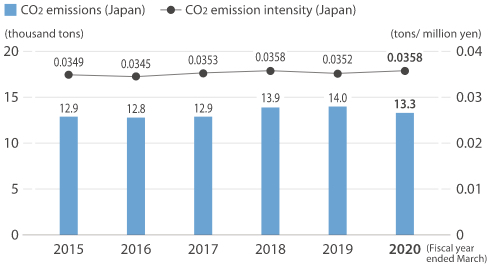
To reduce CO2 emissions in the supply chain, we are working to streamline logistics. As important measures, we are reducing transportation distances through round-use of export containers and a review of transportation routes, thoroughly implementing eco-driving during truck transportation, and reducing the use of packing materials through the use of returnable steel containers. In the fiscal year ended March 2020, CO2 emissions during shipment of products in Japan was 13,293 tons/year, and the target of 13,964 tons/year was achieved. However, as a result of a deterioration in the loading ratio due to a sudden decrease in sales and other factors, our CO2 emissions intensity was 0.0358 tons/million yen, and we were not able to achieve the target of 0.0345 tons/million yen target. In order to further reduce emissions intensity, the entire company will strive to improve logistics efficiency by expanding the scope of measures and reducing current inventories.
■CO2 emissions and emissions intensity in logistics
Validation opinion by a third party on CO2 emissions
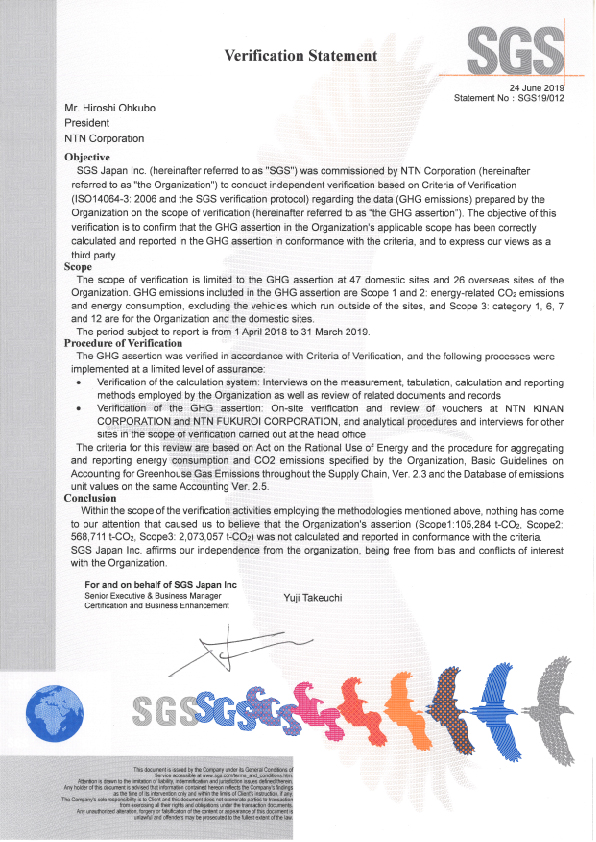
A third-party verification of CO2 emissions for the fiscal year ended March 31, 2020 was conducted, confirming that there were no issues with the method for calculating CO2 emissions.
| Validation opinion | (PDF: 1,418KB) |
|---|
Adaptation to climate change
The NTN Group contributes to society by developing new products that provide the safety and security of people living in areas affected by the severe disasters that have occurred frequently in recent years.
Development of products that respond to the intensification of natural disasters
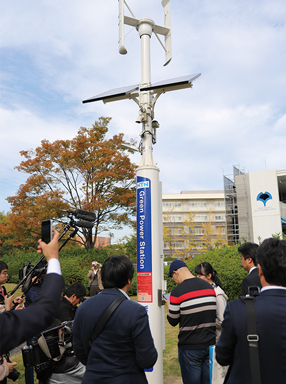
N3N-CUBE, NTN Green Power Station
We have developed the N3 N-Cube that stores power generators and storage batteries utilizing three types of natural energy (wind, water and sunlight) and that can be used as urgent power sources in the time of disasters that make it difficult to supply electricity. The N3 N-CUBE can generate and supply electricity in a short period of time. In September last year, the N3 N-CUBE was sent Kyonan-machi, Chiba Prefecture, where it became difficult to supply electricity due to the Typhoon No. 15 disaster. The N3 N-CUBE was used to recharge approximately 1,000 mobile phones and provide free Wi-Fi spots. In addition, we succeeded in implementing "Long Distance Wireless Transmission Experiments between Bases" with the National University Corporation Osaka University, which uses NTN Green Power Station to quickly ascertain the status of a disaster when it occurs. Since this system can collect and transmit disaster information safely and swiftly and can also be used as an independent power source in the event of a power loss, we will promote initiatives to bring this system into every local government.
■"N3 N-CUBE " that was temporary staff to Kyonan-machi, Chiba
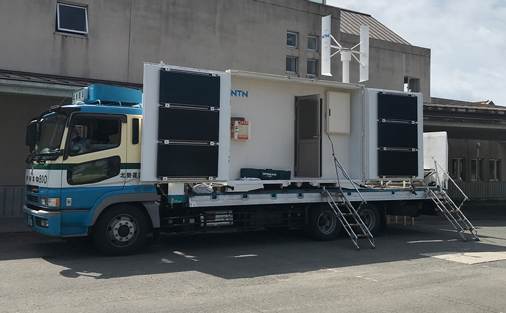
■NTN Green Power Station