CSR activities in FY2018
Corporate Governance
Basic Approach and Implementation System
Basic Approach
Strengthening and enhancing our corporate governance is one of our top management priorities. We take steps to make management more efficient and robust while working to increase management transparency by disclosing information in a prompt and accurate manner to shareholders and investors.
We made a transition from a Company with Board of Company Auditors to a Company with Nominating Committee, etc. upon the approval of the 120th General Meeting of Shareholders held on June 25, 2019 (for the fiscal year ended March 31, 2019). The purpose of this transition is to establish a prompt decision-making structure and operational execution organization, strengthen the supervision of management, and improve management transparency and fairness. Under this structure, we will work on further improvement of corporate value over the medium- and long-term.
■Corporate governance structure

Board of Directors
The Board of Directors decides the basic
management policies, and supervises the
execution of duties of Directors and Executive
Officers. The Board of Directors considerably
delegates its authority regarding operational
execution to Executive Officers, except matters
stipulated by laws and regulations or the Articles
of Incorporation to be resolved at the Board
of Directors with the aim to strengthen the
supervision of management, and make decisionmaking
more prompt.
The Board of Directors is held once a month
in principle, but it is also held as needed with
flexibility.
The Articles of Incorporation specify that
the term of office of Directors shall be one year,
and the number of Directors shall be within 15.
The number of Directors is 11 as of June 25,
2019, and five of them are Outside Directors.
The Board of Directors is chaired by Director,
President, Executive Officer.
Nominating Committee
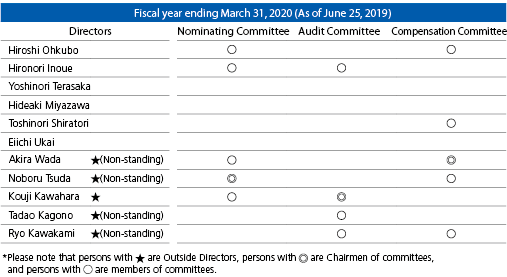
The Nominating Committee decides on the content of a proposal regarding appointment/ removal of Directors, which is submitted to the General Meeting of Shareholders. As prescribed by laws, a half or more of the members of the committee are Outside Directors. Three out of the five members of the committee are Outside Directors, and the committee is chaired by an Outside Director.
Audit Committee
The Audit Committee audits the execution of duties of Directors and Executive Officers, and decides on the content of a proposal regarding appointment/removal of the accounting auditor, which is submitted to the General Meeting of Shareholders. As prescribed by laws, a half or more of the members of the committee are Outside Directors. Three out of the four members of the committee are Outside Directors, and the committee is chaired by an Outside Director.
Also, the Audit Preparation and Support Office is established as an organization dedicated to support the duties of the Audit Committee, including Secretariat of Audit Committee. Regarding matters relating to appointment, personnel relocation, disciplinary punishment, evaluation, etc. of staff of the Audit Preparation and Support Office, the approval from the Audit Committee shall be required for decision.
Compensation Committee
The Compensation Committee decides on the details of the policy for determining compensation for Directors and Executive Officers, and details of compensation for individual persons. As prescribed by laws, a half or more of the members of the committee are Outside Directors. Three out of the five members of the committee are Outside Directors, and the committee is chaired by an Outside Director.
■Members composing Nominating Committee, Audit Committee, and Compensation Committee
Management Meeting
The Management Meeting discusses important matters relating to operational execution, as a supporting body for decision-making of President, Executive Officer. The meeting is composed of President, Executive Officer, and Executive Officers who are designated by him, and held twice a month in principle.
Executive Officers Meeting
The Executive Officers Meeting is held by President, Executive Officer under the attendance of all Executive Officers. Matters resolved at the Board of Directors are instructed, and each Executive Officer reports about the status of operational execution. This meeting is held once a month in principle, to make operational execution more efficient and effective by sharing information among Executive Officers.
Executive Officers
Executive Officers are elected by the resolution of the Board of Directors, and are in charge of executional decision making and execution of operations delegated by the Board of Directors. Its term of office is specified as a year by the Articles of Incorporation. The number of Executive Officers is 15 as of June 25, 2019.
■Basic Information

Governance-strengthening transition
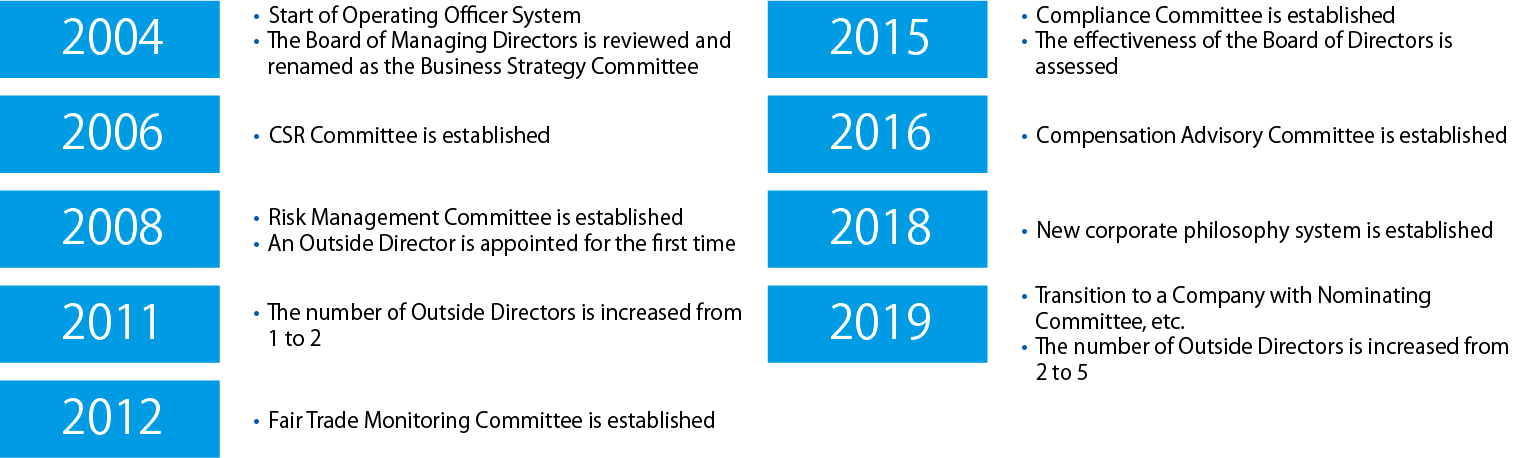
Outside Directors
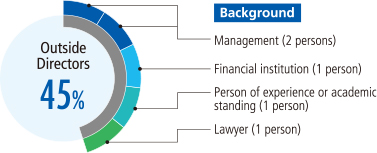
We made a transition from a Company with Board of Company Auditors to a Company with Nominating Committee, etc. at the General Meeting of Shareholders for the fiscal year ended March 31, 2019. As a result, the total number of members of the Board of Directors is 11 (six Inside Directors, five Outside Directors), and the ratio of Outside Directors is 45%. The purpose of this transition is to strengthen the supervision of management and improve management transparency and fairness. In addition, in order to ensure appropriate corporate governance, we have established our own standard for independence of Outside Directors, stipulating qualification and independence standards for them. This standard is used for appointing Outside Directors. Also, all the Outside Directors are designated as independent Officers as defined by the rules of Tokyo Stock Exchange, Inc. (TSE), and are reported to TSE as such.
We send materials related to matters to be discussed at the Board of Directors to the Outside Directors in advance, and hold a briefing on the agenda items beforehand, to enable lively discussion at the Board of Directors. Moreover, we continuously provide information necessary to effectively fulfill the roles and responsibilities of an Outside Director by creating opportunities to deepen the understanding of our business through on-site inspection of business sites and other means.
Roles required of Outside Directors
- Taking part in the important decision-making and supervising the processes done by the Board of Directors
- Drawing on a broad range of knowledge gained through extensive personal experience to provide appropriate advice and suggestions on agenda/report items to be resolved at the Board of Directors.
- Supervising management from an independent standpoint to improve the common interests of the shareholders
Conditions for disposition
Within the Group, which conducts business on a global scale, Outside Directors must not only strengthen corporate governance, but also have required dispositions to aim for global business expansion, namely, achievements as a management, lawyer, certified public accountant, or academic, etc., and possess a wealth of experience and specialized knowledge.
Conditions for independence
An Outside Director must not be and must not have been a Director involved in operational execution, an Executive Officer, an accounting advisor, or employee of the Group at the time of assuming office and for 10 years prior to that.
At the time of assuming office and for three years prior to that, none of the following shall apply: a major shareholder, a main lender, a lead underwriting firm, a main business partner of the Group; an officer of either of those organizations; a person affiliated with the Group’s accounting auditor; or a person who received significant amount of monetary compensation from the Group for consulting, accounting, or legal services.
Assessment of effectiveness of the Board of Directors
We made a self-assessment of the Board of Directors by sending out questionnaires to Directors and Audit & Supervisory Board Members in the fiscal year ended March 31, 2019, to improve effectiveness of the Board of Directors. The result was generally positive, but some opinions were voiced that the effectiveness should have been further improved about the criteria and the number of matters to be discussed at the Board of Directors. Thus, we will continue to make improvements.
Subsidiary management structure
Under the provisions of the Management Rules for Subsidiaries, we maintain a system for subsidiaries management by concluding a letter of confirmation concerning management control with subsidiaries. Under the system, subsidiaries will report the execution status of duties of their directors, and request the Company’s approval for certain matters. In addition, based on the letter of confirmation, we develop systems for internal control, promotion of CSR activities, risk management, promotion of compliance activities, security trade control, and compliance of laws on competition. We also widely notify and operate a helpline (whistle-blower system) to subsidiaries as a contact point for various concerns.
Clarification of control structure by concluding a letter of confirmation concerning management control
- Report the status of execution of duties by subsidiaries’directors
- Application from subsidiaries for the headquarters’ approval for certain issues, on the basis of authorization rules
- Development of internal control system
- Development system for promotion of CSR activities
- Compliance of basic policy of risk management
- Development system for promotion of compliance activities
- Development system for security trade control
- Instruction and audit of compliance of laws on competition
Compensation Advisory Committee
To increase the transparency and objectivity of respective compensation particulars of Directors and Operating Officers, we have established the Compensation Advisory Committee whose majority members are Outside Officers as the advisory body of the Board of Directors.
The compensation of Directors and Audit & Supervisory Board Members is paid on the basis of the "Policy to Determine the Amount of Compensation or its Calculation Method," which was resolved at the Board of Directors.
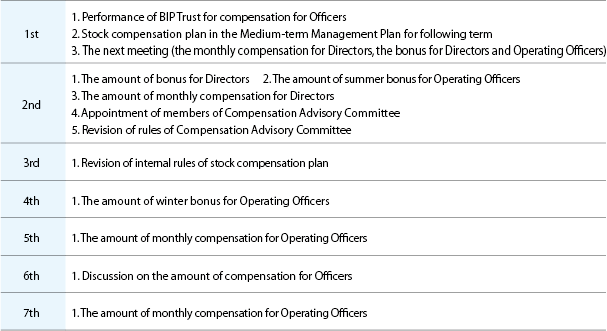
We held seven meetings of the Compensation Advisory Committee in the fiscal year ended March 31, 2019, and held discussions on the compensation system, compensation standards, assessments and amounts of compensation for Directors and Operating Officers.
This committee was changed to the Compensation Committee in June 2019.
Compensation Committee
We made a transition from a Company with Board of Company Auditors to a Company with Nominating Committee, etc., and established the Compensation Committee. The Compensation Committee, the majority consists of Outside Officers, aims to improve fairness, transparency, and objectivity of procedures regarding the decision making of compensation for Directors and Executive Officers and enhance corporate governance. Also, the committee is charged with role of resolving the respective compensation particulars of Directors and Executive Officers.
- The policy and amount of compensation shall be discussed and decided at the Compensation Committee.
- Compensation system
- Directors (excluding those who are concurrently serving as Executive Officers) shall receive only basic compensation, since they are in the position of supervising management (however, compensation for the chairman of the Board of Directors, the chairman of each committee, and members of each committee shall be paid separately).
- The compensation of Executive Officers shall be composed of basic compensation, annual incentive (bonus), and medium- and long-term incentive (stock compensation). (The compensation for the authority of representation shall be paid separately).
- The appropriate level of basic compensation and the performance-linked ratio, etc. shall be set by job position by utilizing objective external research data on a regular basis.
- The payment amount of the annual incentive (bonus) shall be decided in consideration of the status of progress of measures for achieving key targets for each Executive Officer, on the basis of the performance level in the applicable fiscal year.
- Regarding the medium- and long-term incentive (stock compensation), the Company’s shares shall be issued based on the achievement level of major target figures in the Medium-term Management Plan (money equivalent to the converted amount of shares shall be paid for a certain portion) as incentives to motivate them for achieving the targets in the Medium-term Management Plan and raising shareholder value, and in order to promote the holding of the Company’s shares.
- The compensation level and composition shall be discussed at the Compensation Committee in a timely and appropriate manner.
Securing responsiveness to Corporate Governance Code
We take active measures to strengthen our corporate governance while securing responsiveness to the purport of the Corporate Governance Code, including the transition to a Company with Nominating Committee, etc. in June 2019. We have implemented all of the general principles of the Corporate Governance Code. We will continue to work on strengthening our corporate governance while adapting to changes in our business environment.
Cross-held shares
From the perspective of improving our corporate value over
the medium- and long-term, we hold shares of other listed
companies to maintain and strengthen stable and long-term
business relationship. Regarding cross-held shares, we regularly
verify whether or not a shareholding meets the holding
purpose, in consideration of returns and risks including the
trading status, dividends, and share price fluctuations. Holdings
of stocks judged as not meeting the holding purpose will be
reduced in number. We have verified the appropriateness of
the holding of each stock held as of March 31, 2019, and
confirmed that the holdings were appropriate for all stocks.
In principle, we exercise all voting rights of the cross-held
shares. Regarding the voting for or against proposals, we make
such judgments by paying due respect to the management
policy of the company concerned, instead of simply applying
fixed standards. We exercise voting rights by comprehensively
taking into account "whether or not the holding will contribute
to improvement of our corporate value in the medium- and
long-term" and "whether or not the holding will damage
shareholder value."
■Number of stocks and amount
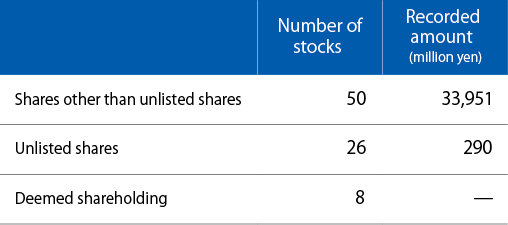
*The details of shares we hold can be viewed on our Securities Report (only in Japanese)